
An Odoo project is broken down into four categories: licenses, integration, training, and operation. Since Odoo 20, the license costs €19.90 per user per month for Standard in the first year (€24.90 thereafter), €35.90 for Customized (€44.90 thereafter), and €7.90 for a Light User, excluding taxes and billed annually. A team of 10 people with 6 collaborators as Light Users pays €127 per month instead of €199.
Odoo a revu ses prix le 24 septembre 2026, pendant l'Odoo Experience, pour la première fois depuis 2022. Le plan Standard ne bouge pas, le Personnalisé prend 20 %, et une licence Light User apparaît pour les collaborateurs qui n'ont besoin que de leurs congés, de la caisse ou du scan en entrepôt. Ce guide détaille la grille, chiffre l'effet sur une équipe de 10 personnes, puis passe aux autres postes d'un projet. Il est écrit par Nuprod, intégrateur Odoo Silver Partner en Gironde. Mis à jour le 19 octobre 2026.
To remember
- Standard: €19.90 then €24.90 per user per month, unchanged. Customized: €35.90 then €44.90, which is 20% more. Prices exclude taxes, billed annually.
- Light User: €7.90 per month, on quote from an Odoo advisor, available only from Odoo 20, with at least one full user.
- Any active employee record without a user account is billed as a Light User.
- For 10 people, 4 Standard users and 6 Light Users cost €1,524 per year in the first year, compared to €2,388 for 10 full users.
- The license is just one of four categories. Integration, training, and operation are priced according to the project's scope.
How much does an Odoo license cost in 2026?
Odoo offers a choice of five options, from €0 to €44.90 per user per month. The table ranks them from the simplest to the most comprehensive.
Offer | Price per user per month, billed annually | Monthly billing | What it includes | For whom |
|---|---|---|---|---|
Community | 0 € | 0 € | The open source software, without hosting, without official support, without the Enterprise applications (full accounting, Studio) | A technical team that hosts and maintains itself |
One App Free | 0 € | 0 € | One application, unlimited users, on Odoo Online | Test Odoo, or use only one module |
Light User | 7.90 €, on quote | Not published | Leave, expense reports, evaluations, attendance, scheduling, on-site interventions, inventory scanning, cash register, workshop, pay slips, read-only knowledge base. Starting from Odoo 20 | Collaborators who manage their own work |
Standard | 19.90 € the 1st year, then 24.90 € | 24.90 €, then 31.10 € | All applications, on Odoo Online. No Studio, no specific development, no external API, no Odoo.sh | A SME with standard needs |
Customized | 35.90 € the 1st year, then 44.90 € | 44.90 €, then 56.90 € | All of Standard, plus Studio, multi-company, external APIs, Odoo.sh hosting or on your server, Odoo 20 AI agents (credits extra) | A company that customizes or develops |
Prix hors taxes, relevés sur odoo.com et chez plusieurs partenaires Odoo en octobre 2026.
Standard or Customized: where is the boundary?
The Standard plan is sufficient as long as you stay on Odoo Online, without code. Customized becomes necessary as soon as the project requires one of these five elements:
- a specific module, developed for you;
- the customization of screens with Studio;
- an API connection to another software, a marketplace for example ;
- multiple companies in the same database ;
- hosting on Odoo.sh or on your server.
The difference is €16 per user per month in the first year, then €20. For 4 full users, count an additional €64 per month in the first year.
[Image: visual "Odoo 20: not all your collaborators need a full license." Alternative text: Comparison of Odoo 20 licenses, Light User at €7.90 and full user from €19.90.]
What is an Odoo Light User?
A Light User manages their own work in Odoo without overseeing the company's activities. They request their leave, enter their expense reports, scan in the warehouse, or handle the cash register. They do not touch sales, purchases, or accounting. Their license costs €7.90 per month.
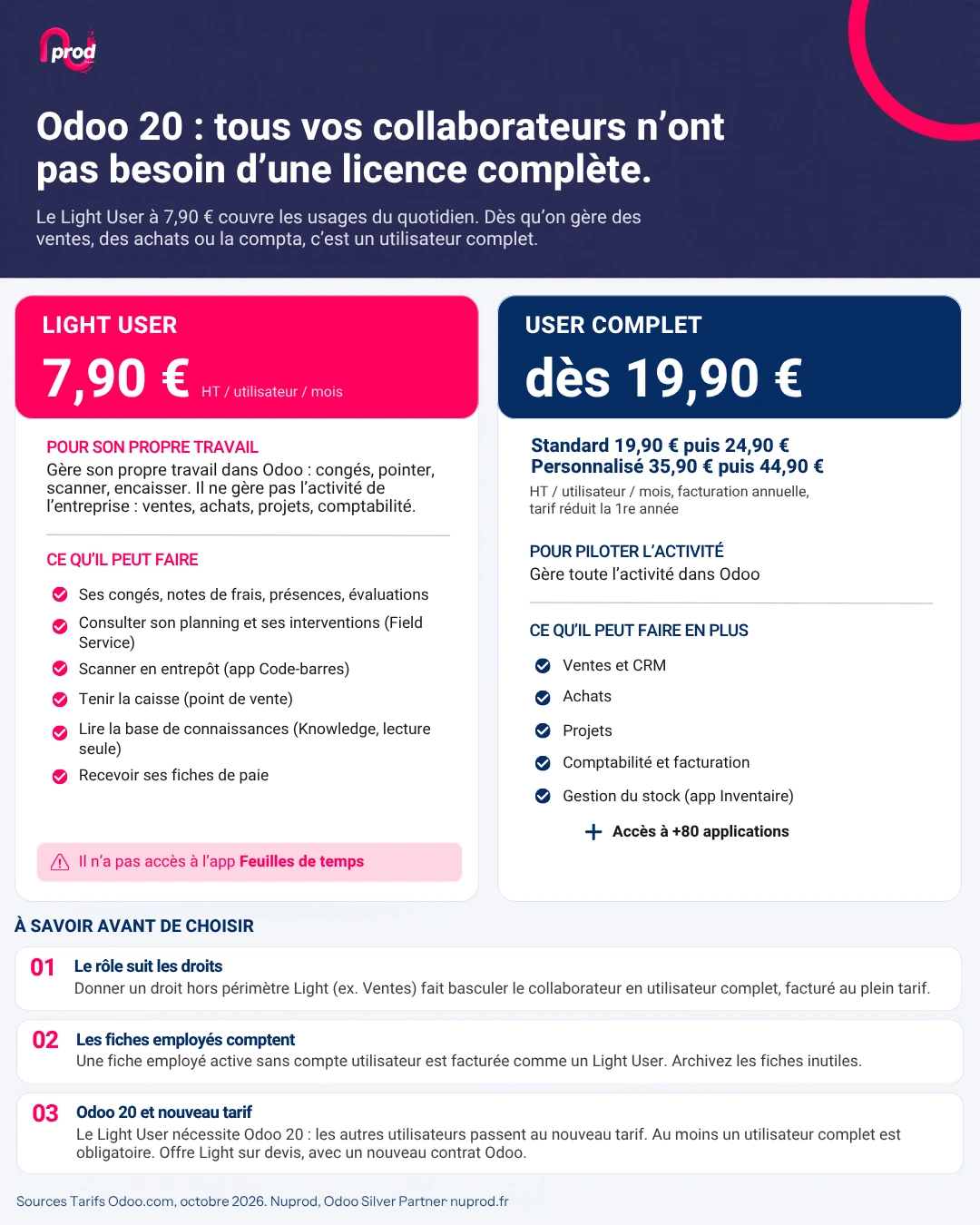
The Light User can | A full user is needed to |
|---|---|
Manage their leave, expense reports, evaluations, attendance, and recommendations | Sales and CRM |
View their schedule and on-site interventions | Purchases |
Scan in the warehouse with the Barcode application | Stock management in Inventory |
Handle the cash register and work in the manufacturing workshop | Projects and timesheets |
Receive their pay slips, read the knowledge base | Accounting and invoicing |
The official Odoo list does not mention timesheets for the Light User. If your teams enter their hours, have it confirmed by your Odoo advisor before signing.
The three rules that change the invoice
1. The role follows the rights. A Light User who receives a right outside of their scope, for example on Sales, becomes a full user, billed at full price. Conversely, removing access to an application is not enough: the account must be designated as a Light User in Odoo.
2. Employee records count. Odoo bills as a Light User any active employee record that is not linked to any active user account. A company with 40 employees, of which 10 use Odoo, therefore pays for 30 Light Users, which is €237 per month, even if these employees never log in. Archive the records of departed individuals.
3. Odoo 20 and a new contract are required. The Light User only exists from Odoo 20, requires at least one full user, and is subscribed via a quote from an Odoo advisor. For an existing base, the upgrade tool to Odoo 20 is announced for the end of November 2026: the Light User therefore first implies a migration.
Numerical example: 10 full licenses, or 4 Standard and 6 Light Users?
Let's take a trading SME of ten people. Four manage the activity in Odoo: the manager, the accountant, a salesperson, and the buyer. Six manage their own work: two preparers who scan in the warehouse, two sellers who handle the counter cash register, a technician who checks his interventions, an assistant who requests her leave and enters her expense reports.
Configuration | Per month, 1st year | Per year, 1st year | Per month, then | Per year, then |
|---|---|---|---|---|
10 Standard users | 199.00 € | 2,388 € | 249.00 € | 2,988 € |
4 Standard users and 6 Light Users | 127.00 € | 1,524 € | 147.00 € | 1,764 € |
Savings | 72.00 € | 864 € | 102.00 € | 1,224 € |
Calculation excluding taxes, billed annually, on the Standard plan. Over three years, the savings reach 3,312 €.
With the Customized plan, the gap widens: 191 € per month instead of 359 € in the first year, then 227 € instead of 449 €.
Two caveats before budgeting:
- The price of the Light User is set by quote. The 7.90 € is the rate announced by Odoo: have it confirmed.
- The distribution depends on actual rights. A counter seller who also creates quotes in Sales becomes a full user again.
How much does Odoo integration cost?
Integration is measured in days of work by the integrator. Six factors vary this number: the scope, data migration, specific developments, connections to other software, the organization of the company, and the availability of your teams.
Factor | What drives up the budget | What contains it |
|---|---|---|
Scope | Eight applications deployed at once | Two or three applications, then others in waves |
Data migration | All history, uncleaned files | Customers, items, and current stocks |
Specific developments | A module for each deviation from the standard | The standard first, Studio next, the code last |
Connections | Online store, marketplace, bank, carriers, business software, each in its own development | Existing connectors, like nuDelivery for carriers |
Organization | Multiple companies, sites, or currencies from the start | A pilot site, then duplication |
Availability of your teams | No internal reference | A reference who quickly validates choices |
A specific development counts twice. It costs days of integration, and it imposes the Customized plan, which is 16 € more expensive per user per month in the first year.
Dans tous les cas, exigez un devis poste par poste, avec le nombre de jours par phase. C'est la seule façon de comparer deux intégrateurs sur le même périmètre.
Training and operation: costs after startup
Training
Elle se chiffre en jours, métier par métier : comptabilité, vente, atelier, entrepôt. Si l'organisme de formation est certifié Qualiopi, votre OPCO peut la financer, selon son accord. Nuprod est certifié Qualiopi.
Operation
Position | What to plan for |
|---|---|
Hosting | Included on Odoo Online. Odoo.sh is billed separately. On your server, hosting and maintenance are your responsibility |
Integrated purchase credits | SMS, automatic contact completion, lead generation, reading supplier invoices and expense reports by AI. Odoo 20 AI agents also consume credits, purchased separately |
Annual version upgrade | The upgrade is included in the subscription. The integrator's time to adapt specific modules and test is not. |
Support | A contract with your integrator: channels, response times, hours included. |
The more specific developments a project has, the more expensive each upgrade becomes. This is another reason to prioritize the standard.
Six ways to reduce the bill without depriving yourself.
- Assign roles person by person before signing. List who creates quotes, orders, or invoices, and who only manages their own work. Each person in the second group can switch to Light User.
- Archive unnecessary employee records. Each active record without a user account costs €7.90 per month, including for a departed employee.
- Stay on Standard as long as the standard is sufficient. A development or Studio moves all your full users to the Custom plan.
- Prefer annual billing. The Standard plan costs €19.90 per month for the first year, compared to €24.90 with monthly billing.
- Test with One App Free. One application, unlimited users, at no cost: enough to validate the CRM or billing before going further.
- Calculate the gain from migrating to Odoo 20. The Light User only exists from this version. For a team with many field profiles, the savings can fund part of the migration.
Frequently asked questions about the price of Odoo
How much does Odoo cost per month?
For a full user, billed annually and excluding taxes: €19.90 the first year then €24.90 on the Standard plan, €35.90 then €44.90 on the Customized plan. A Light User costs €7.90. One App Free and the Community edition are free.
Is Odoo free?
Partially. The Community edition is open source and free, but hosting, maintenance, and support are your responsibility. The One App Free offer provides one application, with unlimited users. All applications together require a Standard or Customized subscription.
What is a Light User in Odoo 20?
A collaborator who manages their own work: leave, expense reports, attendance, scheduling, interventions, cash register, inventory scanning, workshop, pay slips. They do not manage sales, purchases, or accounting. Their license costs €7.90 per month, upon quote.
Are employees without an Odoo account charged?
Yes. Since the new grid, Odoo charges as a Light User any active employee record that is not linked to any active user account. Archive the records of departed employees.
Is the Light User available on Odoo 19?
No, it only exists from Odoo 20. For an existing base, the upgrade tool to Odoo 20 is announced for the end of November 2026.
How much does Odoo integration cost for an SME?
Cela dépend du périmètre, de la reprise des données, des développements et des connexions à d'autres logiciels. L'intégration se chiffre en jours : demandez un devis poste par poste. L'audit gratuit de Nuprod cadre le périmètre avant tout devis.
The right budget starts with the right distribution of licenses.
With Odoo 20, the price of a project depends as much on the distribution of roles as on the number of people. List who drives the activity and who manages their own work, choose Standard or Customized according to your development needs, and then get the integration priced item by item.
Nuprod, intégrateur Odoo Silver Partner en Gironde, répartit vos licences, prépare la migration vers Odoo 20 et chiffre votre projet. L'audit gratuit commence par la liste de vos utilisateurs et de leurs rôles.