
Choosing an ERP in 2026 has become a strategic decision for all SMEs that want to increase productivity, automate their processes, and manage their activities effectively.
Yet, many companies still invest in business management software without a real methodology:
- too complex ERP,
- hidden costs,
- poor support,
- low team adoption,
- incomplete automation.
Result:
- time loss,
- cost explosion,
- underutilized tools,
- nearly zero return on investment.
In this very practical guide, we will see:
- how to intelligently choose ERP for SMEs,
- the most common mistakes,
- the truly important criteria,
- and why Odoo ERP is becoming the preferred choice for many French SMEs today.
Why choosing an ERP has become essential in 2026
In 2026, SMEs must manage:
- more data,
- more tools,
- more automation,
- more customer requirements.
The problem?
Many companies are still operating with:
- Excel,
- multiple unconnected software,
- duplicate entries,
- time-consuming manual processes.
This operation limits:
- growth,
- profitability,
- visibility,
- responsiveness.
A modern ERP allows you to centralize all activities in a single tool:
- CRM,
- sales,
- quotes,
- purchases,
- production,
- inventory,
- accounting,
- HR,
- customer service,
- e-commerce.
Today, it is the foundation of any digital transformation for SMEs.
What is the best ERP for SMEs in 2026?
There is no single "best ERP for SMEs."
The right ERP depends on:
- your industry,
- your size,
- your processes,
- your digital maturity,
- your growth objectives.
But certain criteria become essential.
Essential criteria for choosing an ERP for SMEs
1. An easy-to-use ERP
An overly complex ERP is often rejected by teams.
Usability becomes a major criterion.
2. A scalable solution
Your business will evolve:
- new employees,
- new processes,
- new markets,
- new tools.
Your ERP must keep up with this growth.
3. A strong automation capability
The true ROI of an ERP often comes from:
- automation,
- error reduction,
- time savings.
4. A modular architecture
SMEs today are looking for ERPs that can evolve gradually.
This is precisely what explains the massive growth of Odoo ERP.
Why Odoo ERP is so appealing to SMEs
Odoo has become one of the most popular ERPs among French SMEs.
And it's not by chance.
An ideal modular approach for SMEs
Unlike heavy and rigid historical ERPs, Odoo allows for a gradual start.
You can start with:
- CRM,
- quotes,
- sales,
- invoicing.
Then you can add:
- inventory,
- production,
- accounting,
- HR,
- maintenance,
- e-commerce.
This approach significantly reduces:
- project risks,
- initial costs,
- resistance to change.
A modern and intuitive interface
User adoption is a key success factor for ERP.
Many historical solutions suffer from:
- aging interfaces,
- complex workflows,
- poor user experience.
Odoo offers a much smoother and more modern interface.
Result:
- faster training,
- better adoption,
- immediate productivity gain.
An excellent cost/flexibility ratio
SMEs are looking for today:
- a flexible ERP,
- without excessive costs,
- capable of adapting quickly.
Odoo perfectly meets this logic.
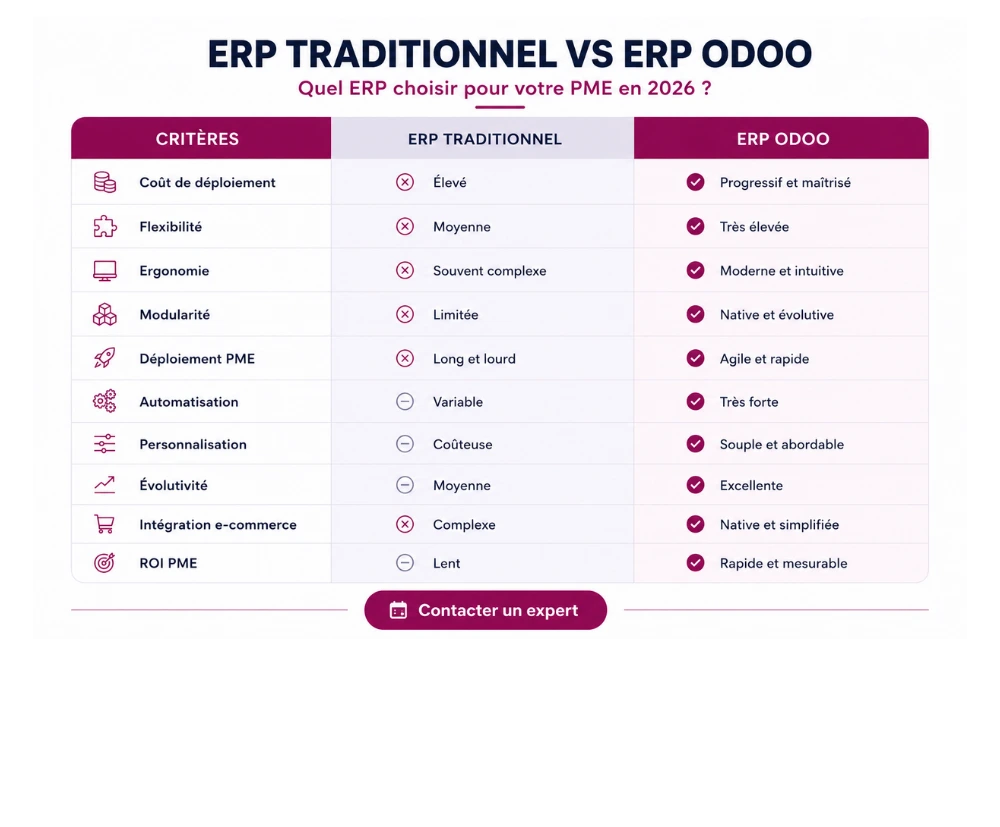
Comparison table: Traditional ERP vs Odoo ERP
| Criteria | Traditional ERP | Odoo ERP |
|---|---|---|
| Deployment cost | High | Progressive |
| Flexibility | Medium | Very high |
| Ergonomics | Often complex | Modern |
| Modularity | Limited | Native |
| SME deployment | Long | Agile |
| Automation | Variable | Very strong |
| Customization | Costly | Flexible |
| Scalability | Medium | Excellent |
| E-commerce integration | Complex | Native |
| SME ROI | Slow | Fast |
The 7 mistakes to avoid when choosing an ERP
Mistake #1: choosing an ERP solely based on price
This is the most common mistake.
A cheaper ERP at first can become extremely costly:
- lack of automation,
- additional developments,
- poor adoption,
- future migration.
The right reasoning is not:
“What is the cheapest ERP?”
But:
“Which ERP generates the most value?”
Error #2: not starting from business needs
An ERP project should always start with:
- the processes,
- the teams,
- the business pain points.
Not by technology.
The right questions to ask
Where are you losing the most time?
Examples:
- data re-entry,
- inventory management,
- quote validation,
- manual reporting.
What tools are you using today?
Identify:
- duplicates,
- limitations,
- information losses.
What gains are you looking for?
- automation,
- centralization,
- management,
- productivity.
Talk to an ERP expert for SMEs
Do you want to know if your company is ready for an ERP?
👉 Schedule a callwith a Nuprod expert to analyze your needs and identify potential productivity gains.
Error #3: choosing an overly complex ERP
Many SMEs choose ERPs designed for very large groups.
Result:
- too heavy a project,
- low adoption,
- high costs,
- internal frustration.
The best SME ERP is the one that your teams will actually use.
Error #4: wanting to automate everything immediately
Some companies want to:
- connect everything,
- automate everything,
- transform everything at the same time.
This is often a mistake.
Successful ERP projects progress in stages.
The right ERP method
Phase 1: the fundamentals
Deploy:
- CRM,
- sales,
- invoicing,
- inventory.
Phase 2: optimization
Add:
- advanced automations,
- BI,
- production,
- specific workflows.
This method significantly reduces:
- risks,
- delays,
- resistances.
Error #5: underestimating support
An ERP is not just software.
It is a business transformation project.
Even the best tool can fail without support.
What makes an ERP project successful
A good framing
Define:
- the priorities,
- the objectives,
- the key processes.
A change management
Teams need to understand:
- why the project exists,
- what they will gain,
- how to use the tool.
An effective training
Without training:
- poor adoption,
- errors,
- return to old tools.
Discover our training programsQualiopi Odoo customized and fundable.
How to succeed in an ERP project in SMEs
Step 1: map your processes
Visualize:
- the flows,
- the validations,
- the friction points.
Step 2: prioritize quick wins
Start with high-impact processes.
Step 3: choose a scalable ERP
Your tool must support your growth.
Step 4: choose an experienced ERP integrator
The partner is often as important as the tool itself.
Cloud ERP or on-premise ERP: what to choose in 2026?
The cloud now largely dominates the SME ERP market.
Advantages of the cloud
- access anywhere,
- simplified maintenance,
- reduced costs,
- continuous updates,
- enhanced security.
Why SMEs prefer the cloud
Companies today are looking for:
- more agility,
- less infrastructure,
- faster deployments.
This is also one of the reasons for the success of Odoo ERP.
How much does an SME ERP cost in 2026?
The cost depends on:
- the number of users,
- modules,
- customizations,
- integration,
- support.
But be careful:
the real cost of a bad ERP is often much higher than the price of the software itself.
Signs that it’s time to change your ERP
Your company probably needs a new ERP if:
- your teams are still using Excel everywhere,
- you are doing double entries,
- your tools do not communicate,
- you lack visibility,
- your processes are too manual,
- your growth is slowing down due to organization.
FAQ: choosing ERP for SMEs in 2026
What is the best ERP for SMEs?
It all depends on:
- your business,
- your size,
- your business needs.
Odoo ERP is currently one of the most popular ERPs for SMEs due to its modularity and flexibility.
Why choose Odoo ERP?
Odoo allows for:
- a gradual approach,
- strong automation,
- an excellent cost/flexibility ratio,
- a modern user experience.
How long does an ERP project last?
Depending on the complexity:
- a few weeks,
- to several months.
Why do ERP projects fail?
The main causes are:
- poor scoping,
- lack of support,
- too ambitious a project,
- low adoption.
What budget should be planned for a small business ERP?
The budget depends on:
- modules,
- the users,
- specific developments,
- the integration.
Is an ERP profitable for a small business?
Yes, when it is well chosen.
The gains mainly come from:
- time saved,
- automation,
- reduction of errors,
- better management.
Conclusion: how to choose your ERP wisely in 2026
Choosing an ERP in 2026 is no longer just about buying a simple business management software.
It is a strategic decision that impacts:
- your productivity,
- your organization,
- your profitability,
- your growth.
The small businesses that succeed in their digital transformation are those that:
- move step by step,
- choose an ERP suited to their real needs,
- invest in support,
- involve their teams from the start.
Today, solutions like ERP Odoo finally allow small businesses to access a modern, flexible, and scalable ERP without the constraints of traditional legacy ERPs.
Let's talk about your ERP project
Are you looking for the best small business ERP to structure your growth?
👉 Book a meetingwith a Nuprod expert to identify automations, productivity gains, and the ERP solution best suited for your business.