
For many SMEs, inventory management remains a topic addressed only when a problem arises: a stockout that delays a delivery, an inventory that reveals significant discrepancies, or a supplier order placed urgently because a product was no longer available.
However, behind these difficulties rarely lies a lack of goods. The real problem is often a lack of visibility. When information is spread across multiple software, Excel files, or manual processes, each department works with its own version of reality. Salespeople do not always have the same information as the store, purchasing makes decisions without a global view, and managers sometimes run their business based on incomplete data.
As the company grows, these dysfunctions become increasingly costly. They slow down teams, increase errors, unnecessarily tie up cash flow, and gradually degrade service quality.
The Odoo Inventory Module directly addresses this issue. By centralizing stock movements in an ERP connected to sales, purchasing, logistics, and accounting, it allows SMEs to regain a reliable view of their operations and sustainably improve their processes.
In this article, discover the main benefits of the Odoo Inventory Module and why effective inventory management is now a true growth lever.
The consequences of poor inventory management
Before addressing the solutions, it is useful to understand why inventory management has become a strategic topic for SMEs.
| Difficulty encountered | Consequence for the company |
|---|---|
| Stockouts | Delivery delays, lost sales, and customer dissatisfaction |
| Overstocks | Tied-up cash and increased storage costs |
| Manual inventories | Lost time and risk of errors |
| Scattered information | Slower and less reliable decisions |
| Double entries | Administrative errors and lack of productivity |
Why inventory management becomes a strategic challenge for SMEs
For a long time, inventory management based on a few Excel files or dedicated software could suffice. But as the business grows, references multiply, orders increase, and several collaborators work on the same products. This organization quickly shows its limits.
The problem generally does not come from the teams. It arises from information that circulates poorly between different departments. Sales consult one tool, purchasing works in another, the warehouse has its own methods, and accounting has yet another perspective. Each performs their job correctly, but no one shares a single, up-to-date piece of information.
Poor visibility impacts the entire company
A stock error never concerns only logistics. When a product is announced as available when it is no longer, the entire chain is impacted. Salespeople must inform the customer, the purchasing department triggers an emergency order, the logistics teams modify their schedule, and the manager must handle the consequences of a delivery delay.
Conversely, some companies choose to order more to limit stockouts. This strategy provides a sense of short-term security, but it ties up a significant portion of cash flow and increases storage costs.
The quality of stock management directly influences the overall performance of the company.
The role of an ERP in stock management
An ERP like Odoo does not just display available quantities. Its value lies in its ability to centralize all information related to the movement of goods. Supplier receipts, sales, internal transfers, order preparations, and inventories automatically feed into a common database.
Each employee thus works with the same information, regardless of their department. Manual checks decrease, internal exchanges become smoother, and decisions are finally based on reliable data.
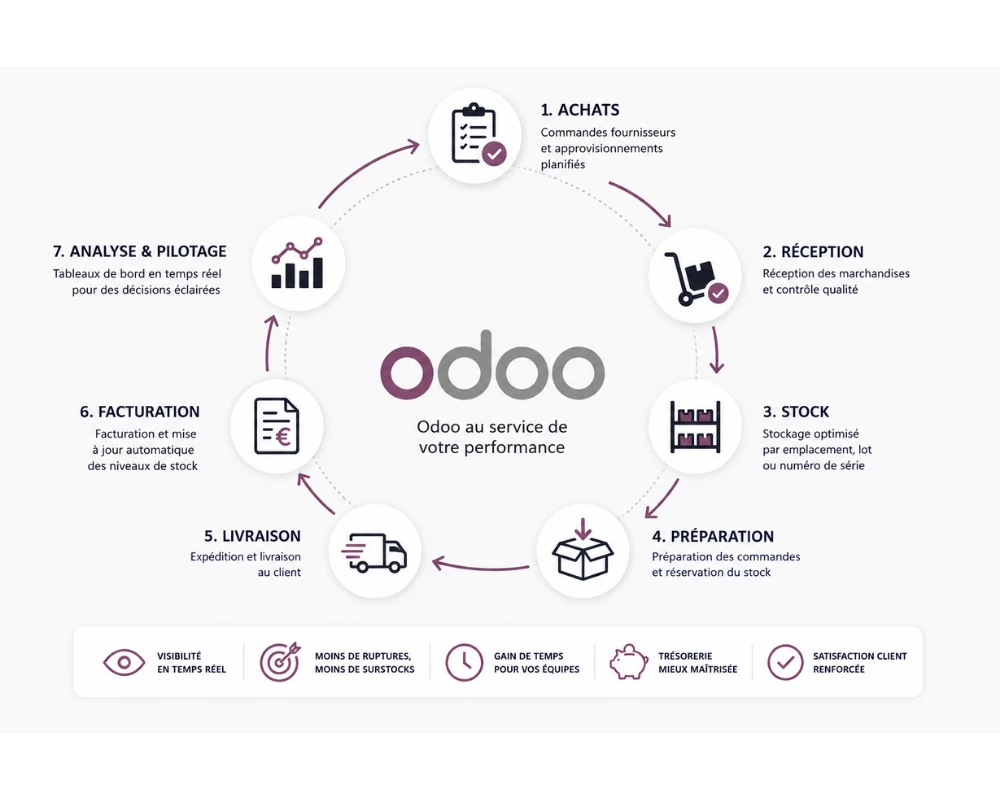
The Odoo Inventory module does not operate alone. It automatically links purchases, stocks, sales, logistics, and billing so that each movement is reflected across the entire company.
1. Have a real-time view of stocks
The first benefit of the Odoo Inventory module is undoubtedly the most important: allowing each employee to access reliable information at the moment they need it.
In many SMEs, teams still waste valuable time checking availability before confirming an order or initiating a supply. These checks are often necessary because the data is not updated automatically or is spread across multiple tools.
With Odoo, every supplier receipt, every order preparation, every delivery or internal transfer immediately updates stock levels. Salespeople, warehouse staff, buyers, and managers thus have a common view of the activity.
Faster and more reliable decisions
This centralization transforms the way stock is managed. Managers can identify the most requested items, track movements in real-time, anticipate restocking needs, and quickly detect products whose stock is becoming critical.
For the manager, this visibility provides a major advantage: decisions are based on updated information rather than estimates or one-off checks.
Use case
Let's take the example of a trading company that sells several hundred references. Before the implementation of an ERP, each order validation required a call to the warehouse to confirm product availability. Once stock movements are centralized in Odoo, this step disappears. Salespeople can directly consult stock levels in real-time, and logistics teams can devote more time to their core business.
To remember
A real-time view of inventory reduces internal checks, improves team responsiveness, and secures daily decision-making.
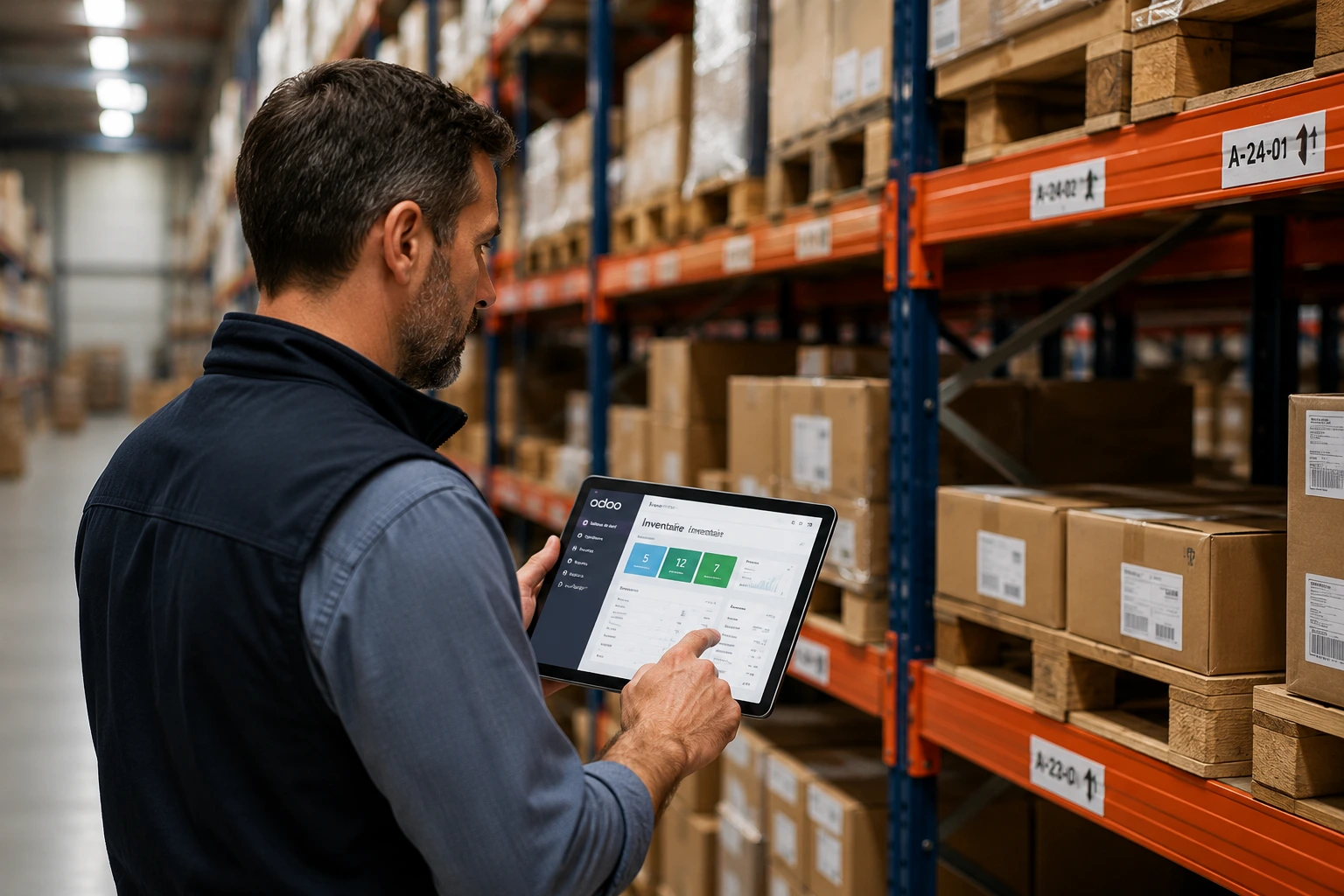 Thanks to the Odoo Inventory module, teams can check stock levels in real time directly from their workstation or a mobile terminal.
2. Reduce stockouts without unnecessarily tying up cash
Stockouts and overstocks are two issues that seem opposed, but often have the same origin: a lack of visibility.
When a company does not know precisely the available quantities or the orders in progress, it generally adopts one of these two strategies. Either it orders more "just in case," or it waits until the last moment to restock. In both cases, the consequences are significant: cash immobilization, urgent purchases, delivery delays, or loss of revenue.
The Odoo Inventory module allows for a much more controlled approach. By tracking stock movements and defining restocking rules tailored to each item, teams anticipate their needs instead of reacting in urgency.
Better control of supplies
Purchases are planned based on reliable data rather than estimates. Managers quickly identify products whose stock reaches a critical threshold, while avoiding the unnecessary accumulation of little-used goods.
This approach simultaneously improves service quality, cash management, and the overall profitability of the company.
To remember
Effective inventory management is not about having more goods. It is about having the right products, at the right time, and in the quantities actually needed.
3. Speed up order preparation and limit errors
As activity increases, order preparation quickly becomes a sensitive point. Poor inventory organization leads to unnecessary movements in the warehouse, product searches, and sometimes preparation errors that directly impact customer satisfaction.
The Odoo Inventory module facilitates this step by organizing the movement of goods and guiding operators in their daily operations. Products are precisely located thanks to storage locations, transfers are automatically recorded, and preparations follow a clear process.
Smoother logistics
Each order follows a defined circuit. Teams immediately know which products to prepare, where to find them, and in what order to carry out the operations. This organization reduces unnecessary handling and limits the risk of errors during shipping.
For companies that handle dozens or hundreds of orders per day, this gain in fluidity represents a true productivity lever.
A better customer experience
A properly prepared and timely shipped order naturally enhances customer satisfaction. Conversely, a preparation error often generates additional costs: product returns, reshipment, administrative time, and sometimes loss of trust.
The quality of inventory management directly contributes to service quality.
To remember
A smoother order preparation allows for time savings, reduces errors, and sustainably improves the customer experience.
4. Ensure complete traceability of products
In certain sectors, knowing the quantities in stock is not enough. It is also necessary to know precisely where a product comes from, where it is located, and to which customer it has been delivered.
The Odoo Inventory module allows for the management of lot numbers, serial numbers, and the movements associated with each item. This traceability becomes particularly important for industrial companies, technical equipment distributors, the food industry, healthcare, and maintenance companies.
Quickly retrieve a product's history
In just a few clicks, it is possible to view the complete journey of an item: its reception, internal transfers, storage, delivery, or any returns.
This visibility also simplifies quality control or product recall operations when necessary.
Meet regulatory requirements
Certain activities impose strict traceability. Centralizing this information in an ERP makes it easier to meet regulatory requirements while reducing the time spent on administrative searches.
To remember
Reliable traceability secures operations, facilitates controls, and improves product tracking throughout their lifecycle.
5. Automate replenishments
One of the main challenges faced by SMEs is ordering at the right time. Too early, inventory increases unnecessarily. Too late, stockouts occur.
The Odoo Inventory module allows for defining replenishment rules tailored to each product. When certain thresholds are reached, the ERP can automatically suggest the quantities to order in order to maintain a stock level consistent with operations.
More predictable purchases
Purchasing teams no longer work solely in urgency. They have a comprehensive view of upcoming needs and can anticipate supplier orders based on actual consumption.
This approach also improves relationships with suppliers through better order planning.
Fewer unnecessary purchases
By relying on the data available in the ERP, the company avoids duplicate orders or replenishments made solely as a precaution.
Inventory management thus becomes more predictable and more profitable.
To remember
Automating replenishments helps limit stockouts while optimizing cash flow.
6. Manage multiple warehouses with a single view
Many SMEs today have multiple storage locations: a main depot, a workshop, a store, or even a warehouse dedicated to e-commerce.
Without the right tool, it quickly becomes difficult to know precisely the availability of products at each site.
The Odoo Inventory module allows you to manage multiple warehouses, multiple locations, and multiple logistics flows within the same environment.
Centralized visibility
Each movement is automatically recorded, regardless of its origin. Managers have a global view of their stocks while maintaining detailed tracking by warehouse or by location.
This organization facilitates internal transfers and improves team responsiveness.
Supporting growth
When a company opens a new warehouse or develops its e-commerce activity, it is not necessary to multiply software. The organization evolves within the same ERP, which significantly simplifies management.
To remember
Multi-warehouse management allows for growth without complicating internal processes.
Why integrate inventory management with the rest of your business?
The true value of an ERP lies not only in the performance of each of its modules but in their ability to work together.
When inventory management software is isolated, teams often have to re-enter the same information in multiple tools. Sales, purchases, accounting, and CRM each work with their own data, which increases the risk of errors.
With Odoo, the Inventory module continuously communicates with all other applications of the ERP.
A validated customer order automatically updates availability. A supplier receipt immediately feeds the inventory. Purchases can anticipate restocking needs and accounting has the necessary information without re-entry.
This continuity between different processes provides a major benefit to managers: a global view of their company.
Decisions are made more quickly, exchanges between departments are simplified, and teams spend more time on high-value tasks rather than searching for or copying information.
The role of Nuprod
At Nuprod, we support SMEs in setting up an Odoo environment tailored to their organization. Our goal is not just to install an Inventory module, but to build a system where sales, purchases, inventory, logistics, accounting, and, if necessary, your e-commerce site work together.
Every company has its own processes, constraints, and objectives. That’s why we prioritize a customized approach, focused on your business needs rather than just the implementation of software.
FAQ: everything you need to know about the Odoo Inventory module
What is the Odoo Inventory module for?
The Odoo Inventory module allows you to manage a company's inventory in real-time. It centralizes the movement of goods, supplier receipts, customer deliveries, internal transfers, and inventories to ensure reliable information shared among all departments.
Is Odoo suitable for SMEs?
Yes. Odoo is particularly suited for SMEs that want to structure their management while maintaining a scalable tool. The company can start with a few modules and then gradually enhance its ERP according to its development.
Can multiple warehouses be managed with Odoo?
Yes. The Inventory module allows for the management of multiple warehouses, several storage locations, as well as transfers between different sites. This feature is particularly useful for companies with a main depot, a workshop, or an e-commerce activity.
Is it possible to track serial numbers or batches?
Absolutely. Odoo supports the management of serial numbers, production batches, as well as complete product traceability. This feature meets the needs of many sectors such as industry, specialized distribution, agri-food, or maintenance.
Can replenishments be automated?
Yes. It is possible to set replenishment rules based on products, minimum stock levels, or production needs. Odoo can then automatically suggest necessary purchases to limit stockouts.
Does the Inventory module work with an e-commerce site?
Yes. When connected to your online store (PrestaShop or Odoo e-commerce), stock levels are automatically synchronized. The availability displayed on the site thus corresponds to the quantities actually present in the company.
How long does it take to set up the Inventory module?
The duration mainly depends on the complexity of your organization: number of references, warehouses, logistical processes, or existing integrations. A prior audit generally helps to define a realistic schedule and identify priorities.
Can the Inventory module be connected with the other Odoo modules?
Yes. It is even one of the main advantages of Odoo. The Inventory module works in conjunction with Sales, Purchases, Manufacturing, CRM, Accounting, Customer Service, or even your e-commerce site to avoid double entries and streamline all processes.
Conclusion
Effective inventory management is not just about knowing how many products are present in a warehouse. It allows for better decision-making, limits stockouts, optimizes cash flow, saves time on a daily basis, and provides better service to customers.
The Odoo Inventory module addresses these challenges by centralizing information and naturally connecting the different departments of the company. However, the success of an ERP project does not solely rely on the software's features. It also depends on its ability to adapt to your processes, your business, and your development goals.
This is precisely the approach we prioritize at Nuprod: supporting each SME in establishing a coherent, scalable, and truly useful Odoo environment for daily operations.
🚀 Free Odoo ERP Audit: identify your productivity levers
Are you wondering if your current organization is still suitable for your business? Do you want to reduce stock errors, automate certain tasks, or finally connect your different tools?
During our free Odoo ERP audit (60 minutes), we analyze your current operations, your business processes, and your goals to identify the most relevant improvement opportunities.
At the end of this exchange, you will leave with:
- an analysis of your current organization;
- the main identified productivity levers;
- concrete recommendations tailored to your business;
- a clear vision of the most relevant Odoo modules for your company.
👉 Book your free Odoo ERP audit and let's discuss your business challenges together.