
Odoo is an open source enterprise resource planning (ERP) software, created in Belgium in 2005. It brings together sales, purchases, inventory, invoicing, accounting, and the website in one place, in the form of applications that can be activated according to needs. An SME can deploy it alone or with a partner integrator.
This guide is aimed at the leader who must decide before getting started: what Odoo is for, what is free, how it is hosted, what a project costs, and when to call on an integrator. Nuprod, an Odoo Silver Partner integrator in Gironde, wrote it based on its projects in industry, BtoB, catering, and e-commerce.
To remember
- Odoo is a Belgian open source ERP, created in 2005, that combines management applications into a single tool.
- Two editions exist: Community, free and self-hosted, and Enterprise, paid per user, with official hosting and support.
- Three hosting modes: Odoo Online, Odoo.sh, or your own server.
- For an SME, the budget depends as much on integration, training, and support as on the license.
- Odoo 20, presented on September 24, 2026, adds AI agents to the company's processes.
Odoo, what exactly is it?
Odoo is a suite of management software that works in a browser. Each application handles a business function: the CRM tracks leads, Sales creates quotes, Inventory manages stock, Invoicing and Accounting keep the records. They all read the same database: an order entered once feeds the stock, the invoice, and the accounting.
This is the definition of an ERP, for Enterprise Resource Planning, or integrated management software in French. It replaces separate tools (quote spreadsheet, invoicing software, stock file) with a single tool where each piece of data is entered only once. The cost of this double entry is detailed in our article on SMEs that still waste time with Excel.
Where does Odoo come from?
Fabien Pinckaers, a Belgian entrepreneur, launched the software in 2005 under the name TinyERP. It became OpenERP in 2008, then Odoo in 2014, when the offering expanded to include the website, e-commerce, and point of sale. The publisher, Odoo S.A., is Belgian. It releases a major new version every year.
What does "open source" mean?
The code of Odoo is public. The Community edition is distributed under the LGPLv3 license: any company can download it, modify it, and host it. This openness explains the ecosystem around the software: integrators like Nuprod, and tens of thousands of add-on modules written by third parties.
What is Odoo used for? The applications, categorized by need
Odoo is used to manage a small business in a single tool: selling, buying, storing, manufacturing, invoicing, collecting payments, selling online, and tracking teams. It has over 70 official applications, which are activated one by one. The table classifies the main ones by need.
Need | Odoo Applications | What they replace |
|---|---|---|
Sell | Prospect file, quotes in spreadsheet | |
Buy and store | Supplier orders by email, stock in spreadsheet | |
Manufacture | Manufacturing (bills of materials, production orders), Planning | Workshop tracking on paper or spreadsheet |
Invoice and account | Invoicing, Accounting, Expense reports | Separate invoicing software, re-entering data with the accountant |
Sell online | Showcase site without link to stock | |
Collect payments | Point of sale, cash and catering | Independent cash register, re-entering sales |
Manage teams | Leave, Timesheets, Project | Schedules and tracking hours in spreadsheet |
Communicate | Email Marketing, Marketing Automation, Discuss | Separate emailing and messaging tool |
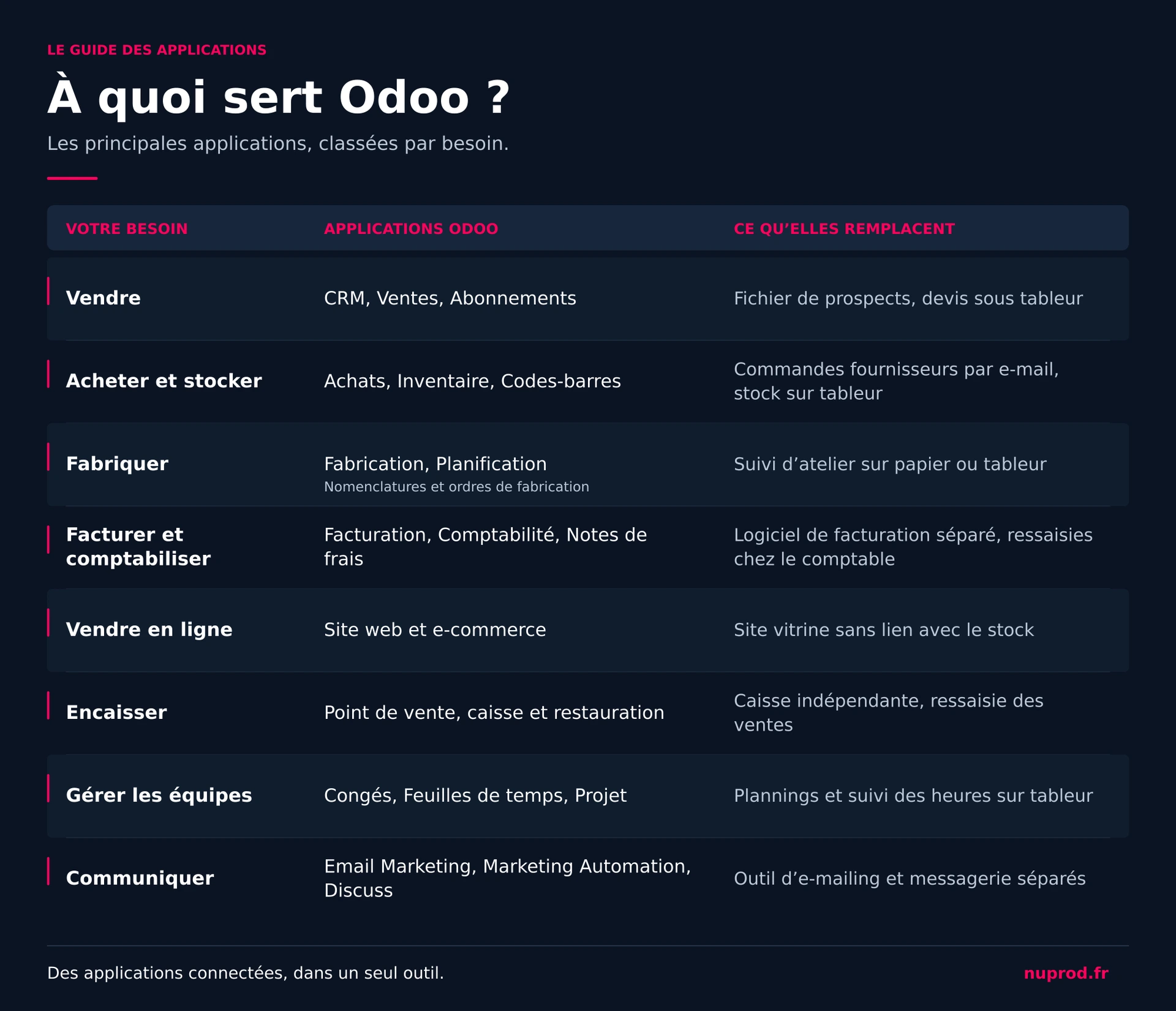
A company only activates what it needs. It often starts with two or three applications, then adds more. At Nuprod, industrial projects mainly rely on manufacturing and connection to CAD tools, restaurants on point of sale, e-commerce merchants on the store and carrier management. Not all applications are available in all editions, as detailed in the following section.
Odoo Community or Enterprise: what’s the difference?
Community is the free and open-source edition of Odoo: you host and maintain it yourself. Enterprise is the paid edition, billed per user: it adds full accounting, Studio, and advanced applications, with hosting, support, and upgrades provided by Odoo S.A.
Criterion | Community | Enterprise |
|---|---|---|
License | Open source, LGPLv3 | Proprietary, subscription per user |
Software price | €0, no user limit | According to the current pricing on odoo.com |
Hosting | At your expense: server, backups, monitoring | Odoo Online, Odoo.sh, or your server |
Official support | No, forums and providers | Yes, provided by Odoo S.A. |
Version upgrades | At your expense | Odoo upgrade scripts and service |
Applications | Core: CRM, Sales, Invoicing, Inventory, Purchases, Project, website | The entire platform, plus complete accounting, Studio, Helpdesk, Planning, On-site Services |
Suitable for | A company that has internal technical skills or an integrator to host and maintain | A SME that wants a managed tool and the complete scope |
In Community, the license is free, but hosting, maintenance, upgrades, and integration time remain to be paid. The Enterprise pricing changes from period to period: the only reliable reference is the one published by Odoo.
How Odoo is hosted: Online, Odoo.sh or on server
Odoo is hosted in three ways: Odoo Online, the online software managed by Odoo S.A., with no specific code; Odoo.sh, a cloud platform that accepts custom developments; or your own server, or that of a host. Odoo Online and Odoo.sh require the Enterprise edition.
Mode | Who manages | Custom developments | Edition | Suitable for |
|---|---|---|---|---|
Odoo Online | Odoo S.A. | No, customization by Studio | Enterprise | A SME with standard needs that does not want any server |
Odoo.sh | Odoo S.A. for the platform, the integrator for the code | Yes, with test branches and deployment | Enterprise | A project that requires specific modules and test bases |
On server | You or your integrator | Yes | Community or Enterprise | A company that wants to control its infrastructure |
The choice comes down to one question: will you need specific developments? If yes, Odoo Online is excluded. Nuprod offers nuDelivery, a carrier management solution compatible with Odoo Online, for e-commerce merchants who remain on this mode.
Is Odoo suitable for a small business?
Yes, if the company has processes well-defined enough to describe them and time to configure them, internally or with an integrator. Odoo is modular and is deployed in stages, which suits structures with a few users as well as those with several dozen. It is less suitable for those looking for a ready-to-use tool, with no configuration.
Nuprod's projects provide a scale. Its profile in the Odoo partner directory shows 54 references: 11 in manufacturing and maintenance, 10 in wholesale and retail, 3 in services and consulting. The average project has 6 users and the largest has more than 40 (Odoo profile, October 6, 2026).
Users also say this on Capterra: Odoo requires defined processes and setup time, which is entrusted to an internal team or a consultant.
When we advise against Odoo
- You have neither the time nor the budget for setup and team training.
- You do not want to review your processes: Odoo follows them, it does not invent them.
- Your need is limited to invoicing. A billing tool alone is sufficient.
For the professions that Nuprod supports, pages detail the use cases: industry, catering and e-commerce.
How much does Odoo cost?
An Odoo project is broken down into four components: the license, integration, training, and operation (hosting, support, version upgrades). The license is free in Community and charged per user in Enterprise. It is just one of the four components.
Component | What it covers | Nature |
|---|---|---|
License | Enterprise subscription per user. Zero in Community | Recurring |
Integration | Needs analysis, configuration, data migration, specific developments | One-time |
Training | Hands-on training by profession, support for the setup | One-time, then with each new hire |
Operation | Hosting, backups, support, annual version upgrade | Recurring |
The Enterprise pricing structure is changing: Odoo has announced a single subscription per user to access the applications. Therefore, we do not publish a price range here. The total depends on the scope, the number of users, and developments. Always request a quote item by item. The free audit from Nuprod helps to define the scope before any quote.
Why go through an Odoo integrator?
An Odoo integrator analyzes your processes, configures Odoo, connects it to your tools, trains your teams, and ensures maintenance. Odoo classifies its partners into three levels: Ready, Silver, and Gold. A Silver partner publishes verifiable references on odoo.com and has trained and certified experts.
Level | What it means |
|---|---|
Ready | A partner who starts and develops their Odoo skills |
Silver | A proven experience with Odoo projects, public references, and certified experts |
Gold | A strategic relationship with Odoo, which is at the heart of the partner's business, with the greatest visibility |
Nuprod has been a Silver partner since September 2025, with three certified experts: two on Odoo 18 and one on Odoo 17.
Four questions to ask before signing
- What level of partnership, and which certified experts will work on my project?
- What references in my field can I call?
- Who configures, and who develops when the standard is not enough?
- What happens after the setup: support, version upgrades, training for newcomers?
Odoo in 2026: what Odoo 20 changes
Odoo 20 was presented on September 24, 2026, at the Odoo Experience in Brussels. The central novelty: AI agents integrated into processes, executing automation described in natural language, for example, transforming a purchase order email into a customer order. The version also affects CRM, purchasing, manufacturing, accounting (with invoice payments from Odoo), point of sale, and the website. It also works offline for field teams.
For a manager, there is no rush: a major version takes several weeks to stabilize before being recommended for production. The details module by module are in our article Odoo 20: all the new features announced at the Odoo Experience 2026. For the uses of AI already possible today, see Odoo and AI: 7 concrete solutions.
Where to start: five steps for a manager
- List your duplicate entries. Note where the same data is re-entered: quotes, inventory, billing, production tracking. One page is enough.
- Choose a starting scope. Two or three applications, those that eliminate the most re-entries.
- Decide on the edition and hosting. Do you need specific developments? The previous sections provide the rule.
- Request a detailed estimate. From one or two Silver or Gold integrators, with references in your field.
- Plan training before the launch. Designate an internal referent who knows your processes.
Nuprod offers a free audit to frame the first three steps.
Frequently asked questions about Odoo
Is Odoo free?
The Community edition is free and open source. The Enterprise edition is paid, per user. In both cases, integration, training, hosting, and support remain to be budgeted.
Who created Odoo?
Fabien Pinckaers, a Belgian entrepreneur, in 2005, under the name TinyERP. He still leads the publisher, Odoo S.A.
Is Odoo a French software?
No. Odoo is Belgian: Odoo S.A. is headquartered in Belgium. The software is available in French, and French partners like Nuprod integrate it.
Is Odoo suitable for a small business?
Yes, from just a few users, provided you define your processes and accept a setup time. On its Odoo profile, Nuprod shows an average project of 6 users.
What is the difference between an ERP and a CRM?
A CRM manages the business relationship: prospects, opportunities, quotes. An ERP covers all management: sales, purchases, inventory, manufacturing, invoicing, accounting. In Odoo, the CRM is an application of the ERP, which links the quote to the inventory and the invoice.
What is the latest version of Odoo?
Odoo 20 was presented on September 24, 2026. As long as it is not stabilized, Odoo 19 remains the reference for a project in production.
Choosing Odoo: four decisions to make, a first step to take
Odoo replaces several tools with one, modular, open source, and Belgian, which is deployed application by application. Four decisions frame a project: the initial scope, the edition, the hosting, and the integrator. The first step is to list your duplicate entries.
Nuprod, Odoo Silver Partner integrator in Gironde, supports SMEs in Bordeaux and Nouvelle-Aquitaine, in industry, catering, and e-commerce. The free audit is the quickest way to know which applications to activate first.