
When SME leaders search for"Odoo website", they usually have several questions:
- Is it really possible to create a professional website with Odoo?
- Can Odoo replace WordPress or other CMS?
- Is the site connected to the CRM, sales, and other management modules?
- Is it a suitable solution for generating leads and growing the business?
The answer is yes.
The moduleOdoo Websiteallows you to create a professional website without complex development while enjoying a major advantage: native integration with your entire ERP. Unlike a traditional CMS, your site is no longer just a communication tool. It becomes a true business lever connected to your forms, your CRM, your quotes, your events, your eCommerce, and your marketing campaigns.
For an SME, this means fewer tools, less data re-entry, more automation, and better visibility across the entire customer journey.
In this comprehensive guide, we will discover what Odoo Website really is, its features, its advantages, and why more and more companies are choosing to centralize their web presence directly in their ERP.
What is the Odoo Website module?
The Odoo Website module is a website builder integrated into the Odoo ERP suite. It allows you to create web pages, blogs, forms, eCommerce stores, and customer spaces using a drag-and-drop visual editor.
The goal is simple: to enable businesses to create and manage their website without having to rely on a developer or external provider for every change.
A platform directly connected to your business
The main difference between Odoo Website and a traditional CMS lies in its level of integration.
With a traditional CMS, the website is often disconnected from the other tools of the business. Information must be transferred manually between the website, the CRM, marketing software, and commercial management tools.
With Odoo, all data is centralized.
When a visitor:
- fills out a form;
- requests a demonstration;
- registers for an event;
- orders a product;
- schedules an appointment;
the information is automatically recorded in the relevant modules.
This continuity between the website and business processes is one of the main advantages of Odoo.
A solution designed for SMEs
SMEs rarely have the resources needed to multiply software and manage complex integrations.
Odoo Website perfectly addresses this issue by offering a unique platform capable of centralizing:
- the website;
- the CRM;
- sales;
- marketing;
- customer service;
- eCommerce.
This approach helps reduce maintenance costs while improving data quality.
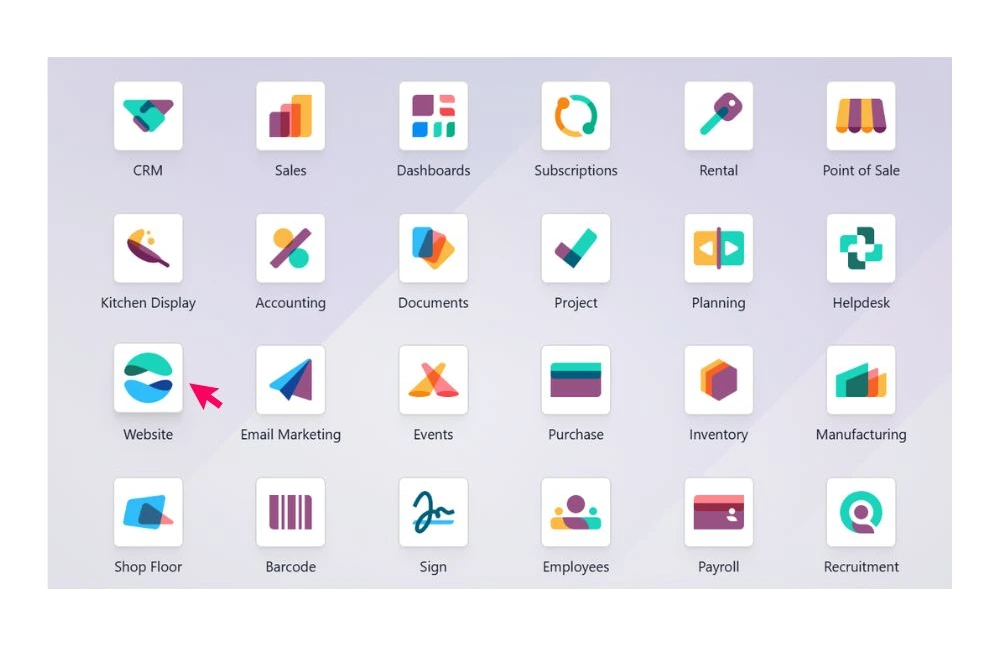
Why do SMEs choose Odoo for their website?
Today, leaders are no longer just looking for an aesthetically pleasing website. They want a tool that can support their business development and accompany the growth of their company.
For a long time, SMEs have built their digital environment around a multitude of solutions:
- a CMS for the website;
- a CRM for prospects;
- an email marketing platform;
- an appointment scheduling tool;
- eCommerce software;
- complementary marketing solutions.
This accumulation of tools often creates information silos.
Teams then spend their time:
- re-entering data;
- exporting files;
- synchronizing software;
- correcting errors.
Centralizing company data
With Odoo Website, the website becomes an integrated part of the management ecosystem.
Information no longer flows between multiple tools. It is directly recorded in the same database as the CRM, sales, or accounting.
This centralization offers several benefits:
- better data quality;
- time savings;
- reduction of errors;
- better visibility on performance.
For a manager, this also means a clearer view of the entire customer journey.
Generate more leads
The website is no longer just a showcase.
It becomes a real acquisition tool.
Each form can be connected to the CRM to automatically create:
- a lead;
- an opportunity;
- a business activity;
- a follow-up task.
Teams thus gain responsiveness and can contact leads more quickly.
Simplify marketing actions
One of the most appreciated features of Odoo Website lies in its connection with other marketing modules.
The site can be directly linked to:
- Email Marketing;
- Marketing Automation;
- Events;
- Appointments;
- Live Chat;
- CRM.
This integration allows for much smoother customer journeys.
For example, a lead can download a guide from the site and then automatically receive a series of emails before being contacted by a salesperson.
The main features of the Odoo Website module
One of the great advantages of Odoo Website is its ability to meet multiple needs without requiring additional software.
A company can start with a simple showcase site and then gradually enhance its platform based on its development.
This modular approach avoids complex projects while offering great scalability.
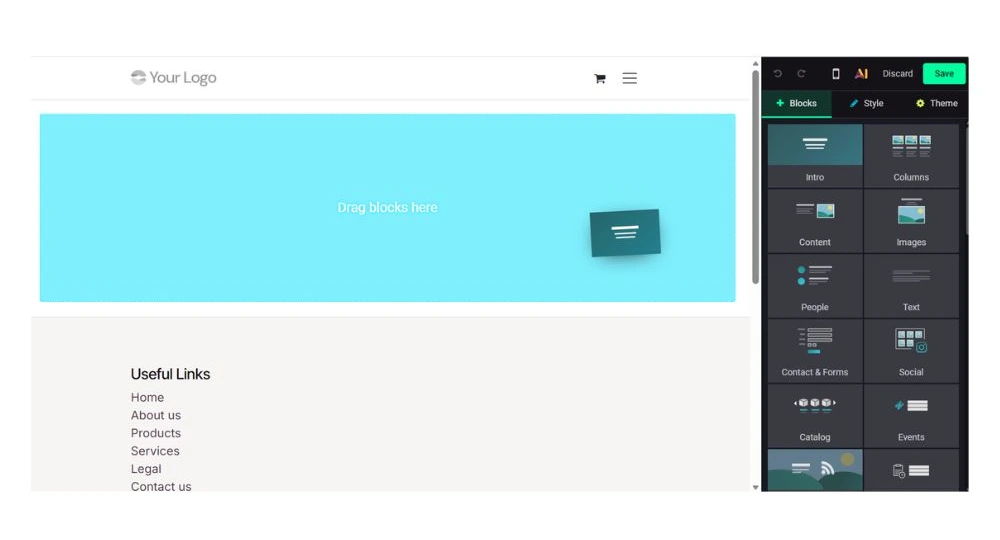
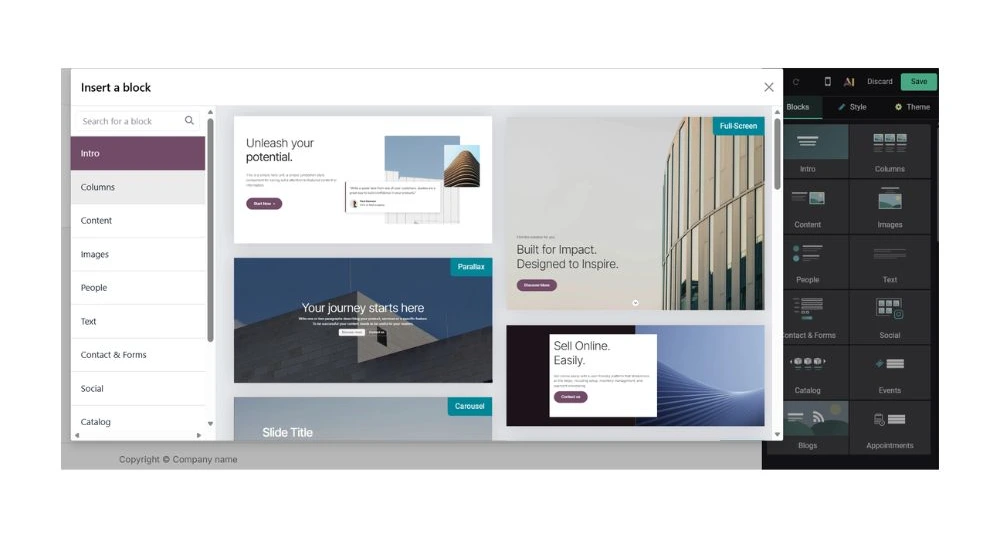
Drag-and-drop page creation
Odoo offers a modern visual editor that allows you to build pages without writing a single line of code.
Thanks to a block system, it is easy to add:
- text;
- images;
- videos;
- buttons;
- forms;
- testimonials;
- calls to action.
This simplicity allows marketing teams to maintain their autonomy.
Integrated blog
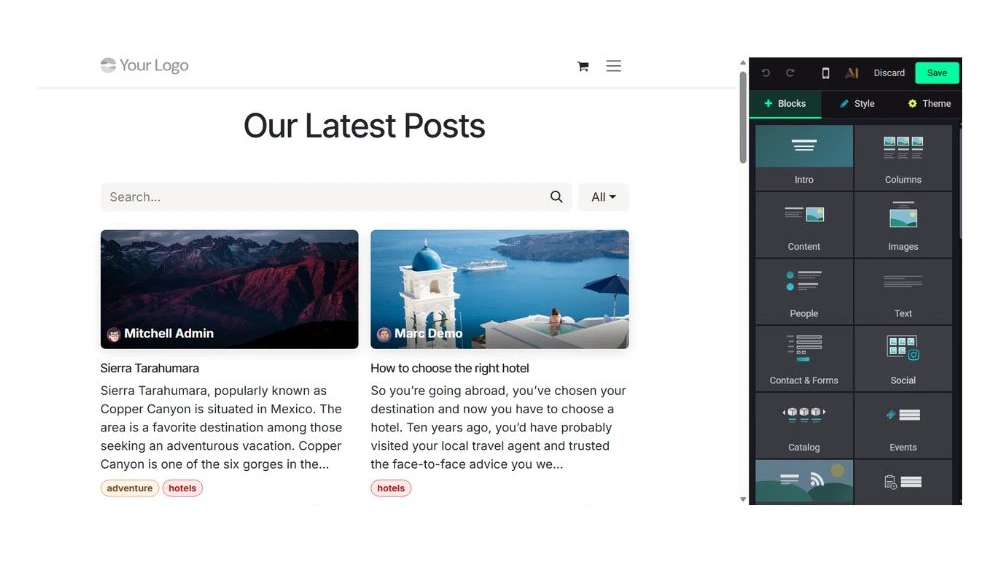
The Blog module allows for regular publication of SEO-optimized content.
This feature is particularly interesting for companies that want to:
- improve their visibility on Google;
- demonstrate their expertise;
- generate qualified traffic;
- attract new prospects.
At Nuprod, we consistently recommend implementing an editorial strategy to transform the site into a true lead generation tool.
Forms connected to the CRM
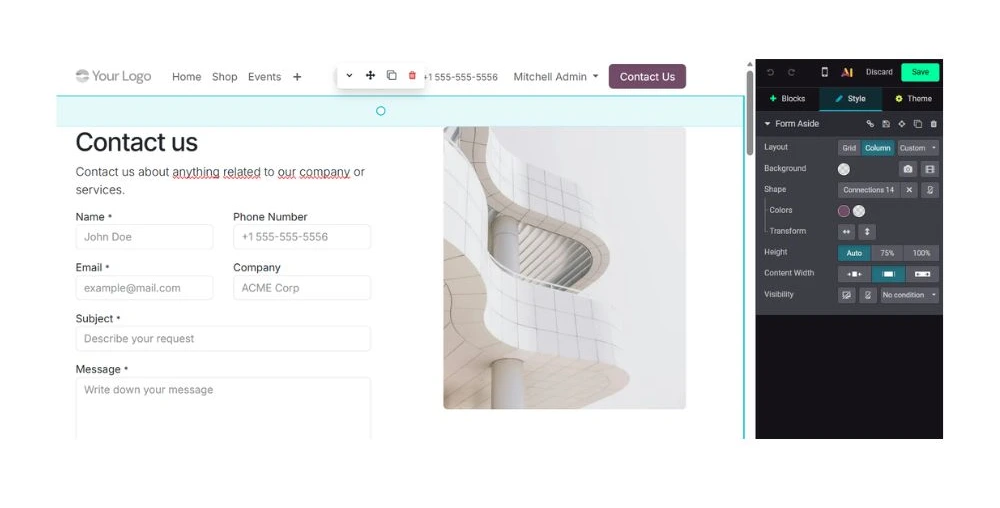
Forms are probably one of the most powerful features of the Website module.
A visitor fills out a contact form.
In a few seconds:
- a lead is created;
- an opportunity appears in the CRM;
- an activity can be assigned to a salesperson;
- a confirmation email can be sent.
No re-entry is necessary.
This automation significantly improves business responsiveness.
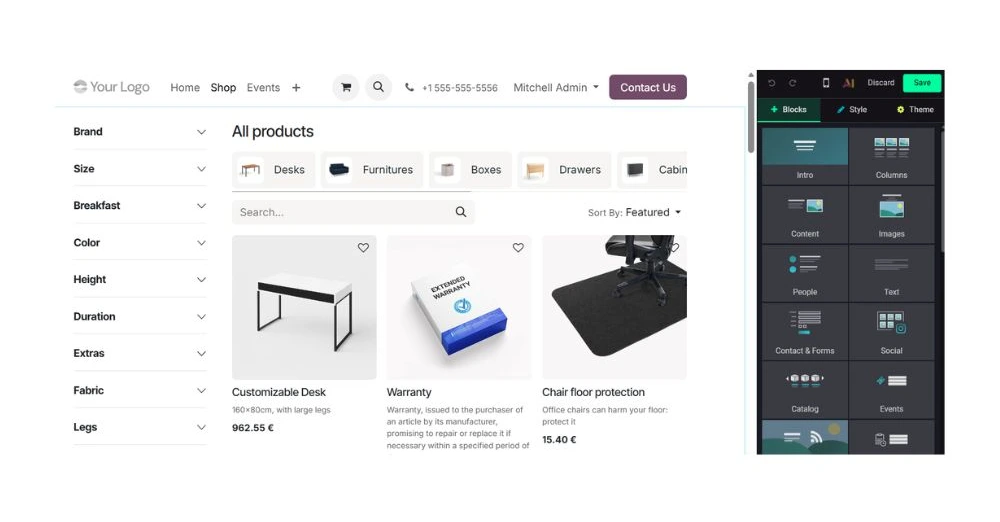
integrated eCommerce
Odoo Website also includes a native eCommerce solution.
A business can sell:
- products;
- services;
- subscriptions;
- training.
Everything is directly connected to:
- inventory;
- sales;
- invoicing;
- accounting.
This integration avoids the complex synchronizations often encountered with external platforms.
Multilingual management
For companies operating internationally, Odoo offers integrated multilingual management.
You can create multiple language versions of your site while maintaining centralized administration.
This feature facilitates international development and helps improve SEO in multiple countries.
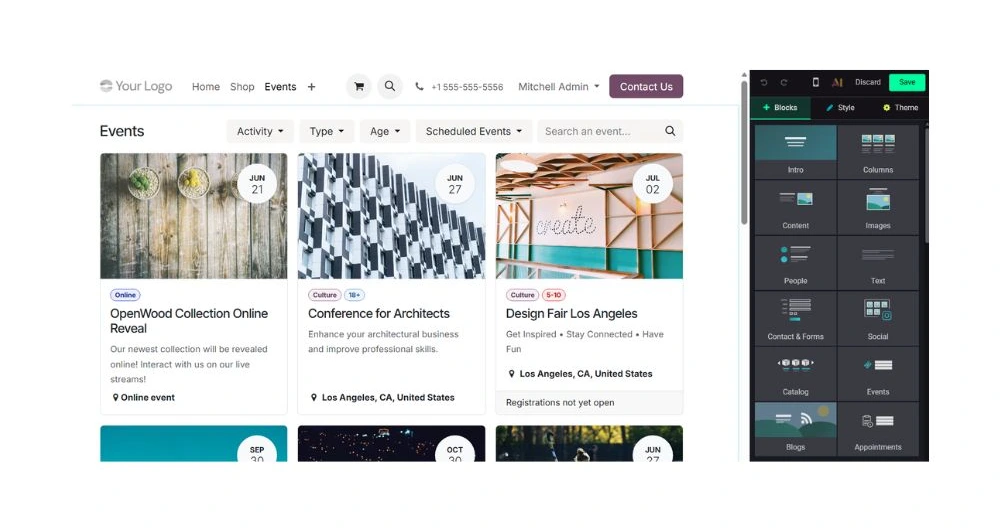
Events and appointment scheduling
The site can also be used to:
- organize events;
- manage registrations;
- offer online appointment scheduling;
- automate confirmations.
These features are particularly useful for service companies, consulting firms, and integrators.
Why do these features really change the daily lives of SMEs?
The interest in Odoo Website lies not only in its ability to create beautiful pages.
Its true strength is in connecting marketing, commerce, and management in a single environment.
When a company uses multiple independent software, it spends a significant amount of time circulating information.
With Odoo, this circulation becomes automatic.
Teams save time, data is more reliable, and leaders have a comprehensive view of their business.
It is precisely this logic of centralization that explains why Odoo Website is increasingly appealing to SMEs looking for a website capable of supporting their growth.
Why do SMEs choose Odoo Website?
| Without Odoo Website | With Odoo Website |
|---|---|
| Separate website | Website connected to the ERP |
| External CRM | Integrated CRM |
| Multiple tools | Unified platform |
| Frequent re-entries | Centralized data |
| Fragmented reporting | Global vision |
And now, how to create a website with Odoo?
One of the great advantages of Odoo Website is its ease of use. Unlike some platforms that require advanced technical skills or the installation of numerous plugins, Odoo offers a visual approach that allows for the quick construction of a professional website.
For an SME, this means greater autonomy in managing the website and a reduction in costs related to technical interventions.
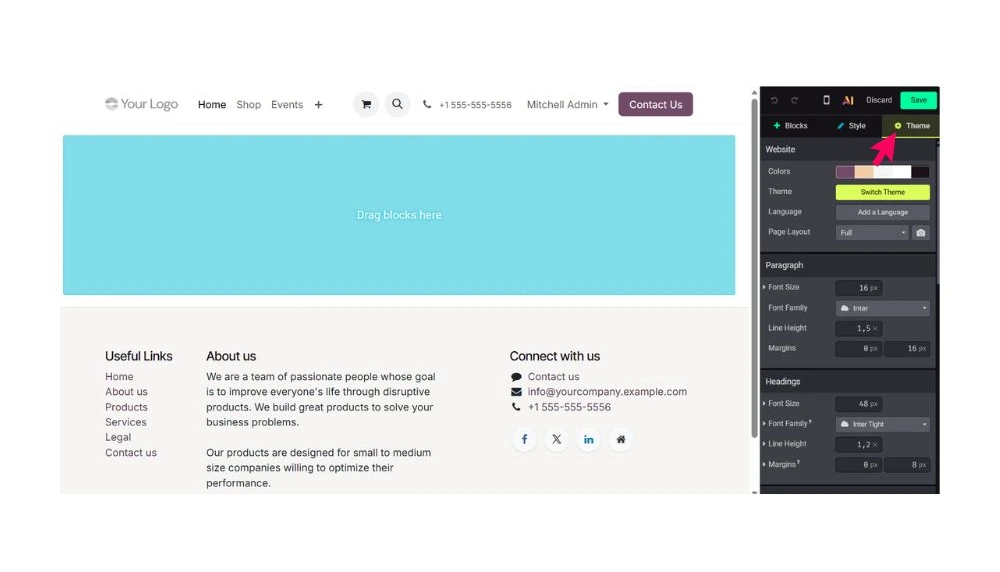
Step 1: Choose a theme suitable for your business
The first step is to select a graphic theme that corresponds to your brand image.
Odoo offers several pre-configured templates that can be customized:
- colors;
- typographies;
- layout;
- action buttons;
- content sections.
The goal is not only aesthetic. A good theme should facilitate navigation, highlight important information, and naturally guide the visitor towards contacting you.
Step 2: Build the essential pages
Most SMEs do not need dozens of pages to achieve results.
A simple and effective structure generally includes:
- Home
- Solutions or Services
- About
- Achievements or References
- Blog
- Contact
Each page should answer a specific question from the visitor.
For example:
The home pageshould quickly explain what your company does.
The Services pageshould detail your offerings and the associated benefits.
The Contact pageshould facilitate appointment scheduling or quote requests.
Step 3: Integrate strategic forms
A high-performing website does not just inform.
It must generate business opportunities.
To do this, forms play a central role.
Some examples:
- Request a demonstration
- Free audit
- Request a quote
- Schedule an appointment
- Download guide
Thanks to the native integration with Odoo CRM, each form can automatically create a business opportunity.
Step 4: regularly publish content
One of the most common mistakes is to consider the website as a completed project once published.
In reality, a high-performing site is constantly evolving.
Regularly publishing articles allows:
- to improve organic search ranking;
- to attract qualified traffic;
- to answer prospects' questions;
- to demonstrate your expertise.
This is precisely why we recommend that businesses implement a true editorial strategy.
SEO on Odoo Website: can an Odoo site be well-ranked?
This question regularly arises among leaders discovering Odoo Website.
The answer is yes.
Odoo now has all the essential features to optimize the organic search ranking of a professional site.
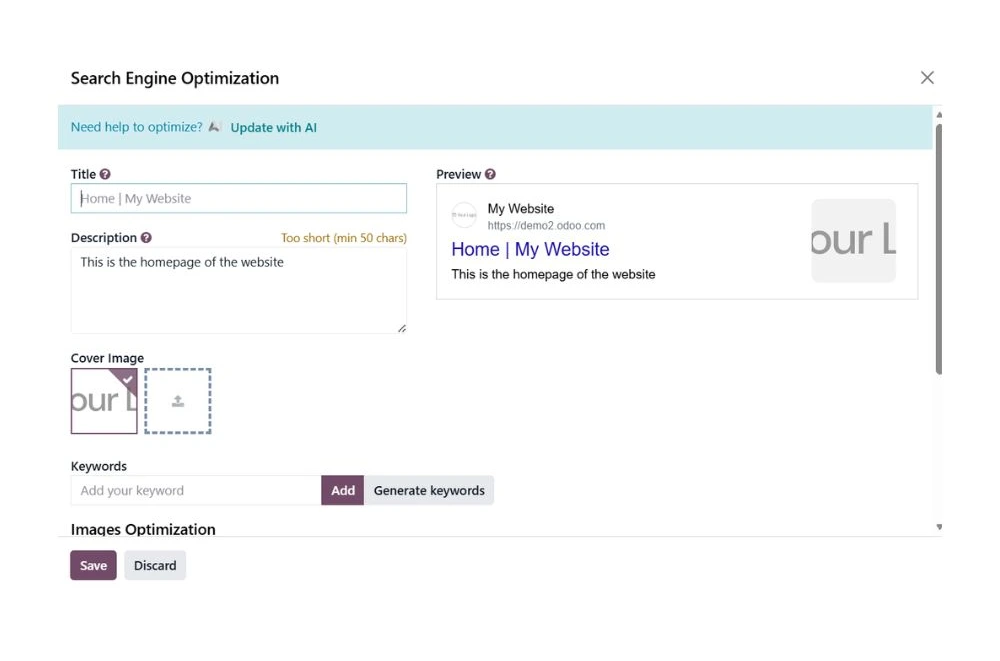
Native SEO features
The Website module allows you to manage:
- Title tags;
- Meta Descriptions;
- custom URLs;
- redirects;
- Open Graph tags;
- H1, H2, and H3 tags;
- XML sitemaps;
- hreflang tags for multilingual sites.
These elements form the technical foundations expected by Google.
Why the blog plays a central role
When a company seeks to enhance its visibility on Google, the blog often becomes its best lever.
Each article addresses a specific issue sought by internet users.
For example:
- How to create a contact form in Odoo?
- How to automate purchases with Odoo?
- How to successfully migrate an ERP?
These contents attract qualified visitors throughout the year.
They also provide an excellent basis for producing:
- LinkedIn posts;
- newsletters;
- YouTube videos;
- tutorials.
SEO best practices to apply
Even though Odoo provides the necessary technical tools, SEO primarily relies on the quality of the content.
To maximize your results:
- target a specific search intent;
- write useful content;
- structure your pages with H2 and H3;
- add relevant visuals;
- work on internal linking;
- publish regularly.
SEO is not a one-time action but a continuous process.
How Odoo Website transforms your site into a lead generator.
Many companies still consider their website as just an online brochure.
However, a modern website must be able to directly contribute to business development.
This is precisely what Odoo Website enables.
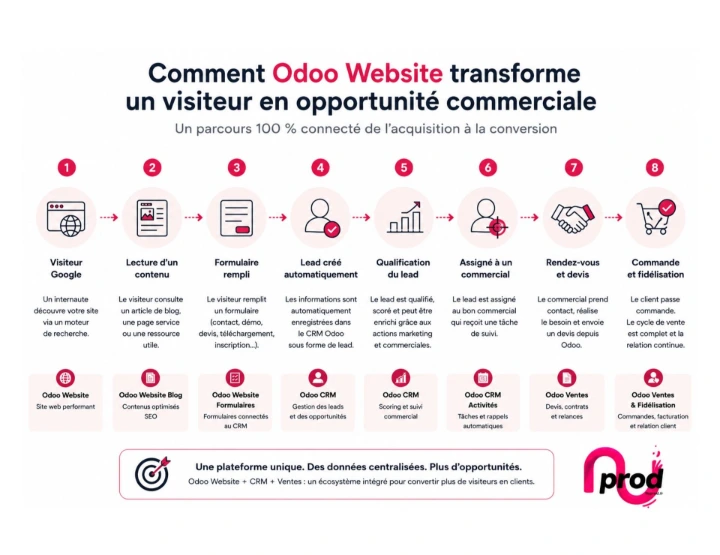
From visitor to customer: a fully connected journey
Let's imagine a concrete example.
A manager searches on Google:
"SME ERP"
They discover an article published on your site.
After reading, they download a guide or request a demo.
In a traditional environment:
- an email is sent;
- someone has to process it;
- a salesperson needs to be informed.
With Odoo:
- the lead is created automatically;
- an opportunity appears in the CRM;
- a salesperson is assigned;
- an activity is scheduled;
- the follow-up starts immediately.
This automation significantly improves business responsiveness.
An alignment between marketing and sales
One of the challenges faced by many SMEs is the lack of coordination between marketing and sales teams.
Marketing generates leads.
Salespeople then have to process them.
When the tools are disconnected, follow-up becomes complex.
With Odoo, the entire journey is centralized.
Teams have a shared vision and can track precisely:
- the origin of leads;
- their level of engagement;
- their progress in the pipeline.
Why is Odoo Website particularly suited for growing SMEs?
As a business grows, its processes become more complex.
Business requests increase.
Teams become structured.
Tools multiply.
This growth can quickly lead to a loss of visibility and an increase in administrative tasks.
A platform capable of evolving with the business
One of Odoo's major strengths lies in its modularity.
An SME can start with:
- Website;
- CRM.
Then gradually add:
- Sales;
- Accounting;
- Marketing;
- Helpdesk;
- eCommerce;
- Invoicing.
This gradual evolution allows for growth without questioning the tools already in place.
Better data management
When all information is centralized in a single platform:
- duplicates decrease;
- errors are reduced;
- reporting becomes more reliable;
- decision-making is facilitated.
For a manager, this visibility represents a significant advantage.
Examples of using Odoo Website in an SME
1. Generation of demo requests
An Odoo integrator can create a dedicated appointment booking page.
Each completed form automatically generates an opportunity in the CRM.
2.Event Management
A company organizes a webinar.
Participants register directly from the site.
Registrations are automatically recorded in Odoo.
3.Recrutement
Candidates can apply from the website.
Their information is transferred to the Recruitment module.
4.Resource Download
A small business publishes:
- a guide;
- a white paper;
- a case study.
The download is conditional on a form.
Each download becomes a potential business opportunity.
Comparison table: Odoo Website vs traditional approach
| Criterion | Odoo Website | Traditional approach |
|---|---|---|
| Website | Integrated | External CMS |
| CRM | Native | Separate tool |
| Forms | Connected | |
| Blog | Integrated | CMS |
| Marketing | Connected | Multiple tools |
| Reporting | Centralized | Fragmented |
| Maintenance | Simplified | Multiple providers |
| Data | Unified | Dispersed |
FAQ: Odoo Website
Can Odoo Website replace WordPress for a small business?
In many cases, yes.
For a small business looking for a modern website, a blog, contact forms, multilingual management, and integration with its CRM, Odoo Website is a particularly relevant alternative.
Its main advantage lies in its native integration with all Odoo modules. While WordPress often requires multiple plugins and connectors, Odoo centralizes data within a single platform.
For companies already equipped with Odoo CRM, Sales, or Accounting, this integration represents a real time and productivity gain.
Is Odoo Website suitable for search engine optimization (SEO)?
Yes.
The Website module has all the essential features to implement an effective SEO strategy:
- Title tags;
- Meta Descriptions;
- Custom URLs;
- XML sitemap;
- Hn tags;
- multilingual management;
- integrated blog.
However, as with any CMS, results primarily depend on the quality of the published content and the consistency of the editorial strategy.
An Odoo site powered by relevant blog articles can become a powerful lever for acquiring qualified traffic.
Can forms be automatically connected to Odoo CRM?
Yes, and this is one of the main strengths of the Website module.
When a visitor fills out a form:
- a lead can be created automatically;
- an opportunity can be generated;
- a salesperson can be assigned;
- automatic actions can be triggered.
This automation helps improve business responsiveness and avoids forgetfulness or manual re-entries.
Can we create a professional blog with Odoo Website?
Absolutely.
The Blog module allows you to easily publish:
- expert articles;
- tutorials;
- news;
- case studies;
- customer feedback.
For SMEs, the blog often represents the best way to improve their visibility on Google and demonstrate their industry expertise.
It is also an excellent resource for feeding social media, newsletters, and marketing campaigns.
Does Odoo Website allow managing multiple languages?
Yes.
Odoo natively integrates multilingual management.
You can create different language versions of your pages while maintaining centralized administration.
This feature is particularly interesting for companies that operate internationally or wish to enhance their visibility in multiple markets.
Good multilingual SEO practices are also supported through dedicated tags.
Can we create an eCommerce store with Odoo Website?
Yes.
The eCommerce module allows you to sell:
- physical products;
- services;
- subscriptions;
- training courses;
- services.
Everything is directly connected to:
- inventory;
- sales;
- invoicing;
- accounting.
This centralization significantly simplifies the daily management of the business.
Odoo Website: much more than just a website
Today, companies are no longer just looking for an aesthetically pleasing website.
They need a tool that can support their business development, improve the flow of information, and simplify their processes.
This is precisely what Odoo Website offers.
By centralizing the website, CRM, forms, marketing, and sales within a single platform, Odoo enables SMEs to gain efficiency while improving their ability to generate and track business opportunities.
Whether you want to:
- create a new website;
- redesign your current site;
- improve your SEO;
- connect your site to your CRM;
- generate more leads;
Odoo Website is now one of the most comprehensive solutions to support the growth of your business.
Do you have an Odoo website project?
A high-performing website is not limited to its design.
It must be able to generate opportunities, automate certain tasks, and integrate seamlessly with your business processes.
At Nuprod, we support SMEs in:
- the creation and redesign of Odoo websites;
- the implementation of forms connected to the CRM;
- SEO optimization;
- lead generation;
- marketing automation;
- the complete integration of the Odoo ecosystem.
Request a personalized demonstration
Discover how Odoo Website can integrate with your business and contribute to your commercial development.
Book a discovery call with a Nuprod expert
Let's discuss your goals, constraints, and digital project to identify the best optimization opportunities.
Train on Odoo Website
Gain independence in creating and managing your Odoo website.
With Nuformations, learn to create pages, manage your forms, optimize your SEO, and fully leverage the potential of Odoo Website.