
For a long time, digital transformation was seen as a project reserved for large companies. Today, the reality is quite different:digitizing a small businesshas become a true lever for competitiveness, productivity, and growth.
Yet, many leaders still hesitate to take the plunge. Between Excel files, software that does not communicate with each other, repetitive administrative tasks, or a lack of visibility on operations, it can sometimes be difficult to know where to start.
The good news? A successful digital transformation does not mean replacing all your tools overnight. It is primarily based on a method, a clear vision, and solutions tailored to your business.
In this guide, discoverthe 7 essential steps to digitize a small business, avoid the most common mistakes, and build a more efficient organization with a modern ERP like Odoo.
📌 Key points to remember
✔ The digitization of a small business is a strategic project, not just a change of IT tools.
✔ A centralized ERPallows you to connect your sales, purchases, inventory, accounting, CRM, and website on a single platform.
✔ Companies that succeed in their digital transformationadvance step by step: audit, objectives, tool selection, team support, automation, and continuous improvement.
✔ The benefits are quickly measurable.: time savings, reduction of errors, better visibility on activities, and increased productivity.
✔ The success of an ERP project depends as much on the method as on the technology.. Appropriate support is essential to ensure adoption by the teams.
Why has digitizing a small business become a strategic issue?
Digitization is not just about replacing paper with digital tools. It transforms the way a company works, collaborates, and makes decisions.
Today, most small businesses use several independent software programs:
- accounting software;
- a CRM;
- quotation software;
- Excel for inventory;
- a shared calendar;
- a website not connected to the rest of the company.
This proliferation of tools quickly leads to several difficulties:
- data re-entry;
- input errors;
- loss of information;
- lack of visibility;
- decreased productivity.
As the company grows, these problems become a barrier to development.
In contrast, a small business that centralizes its processes around an ERP benefits from a global view of its activities and automates a large part of low-value tasks.
The main obstacles faced by small business leaders.
When we assist companies in their digital transformation, the issues are often the same.
Leaders explain to us that they spend too much time searching for information, that their teams re-enter the same data multiple times, or that their different software do not communicate with each other.
The most common difficulties are:
✔ multiple software used simultaneously;
✔ Excel files that have become difficult to maintain;
✔ scattered information;
✔ lack of visibility on performance indicators;
✔ time-consuming administrative tasks;
✔ absence of automation.
These obstacles slow down the company's growth and unnecessarily tie up teams on repetitive tasks.
The concrete benefits of a successful digital transformation
A well-executed digitalization produces measurable results.
Companies generally observe:
- a reduction in administrative time;
- better data quality;
- facilitated collaboration between departments;
- better sales tracking;
- a decrease in errors;
- faster decision-making thanks to real-time dashboards.
Technology is not an end in itself.
It becomes a tool in service of the company's performance.
| Before digitalization | After a successful digital transformation |
|---|---|
| Multiple independent software | A centralized platform |
| Manual re-entries | Flow automation |
| Scattered data | Unique and reliable information |
| Excel spreadsheets | Real-time dashboards |
| Low visibility | Global management of the company |
| Manual processes | Automated processes |
| Time loss | Productivity gain |
| Decisions based on estimates | Decisions based on data |
Is your company ready for its digital transformation?
Every SME has a different level of digital maturity. Before choosing an ERP or launching a digitalization project, it is essential to identify the processes that can be simplified and automated.
Book a free diagnosis with a Nuprod expertto assess your needs and define a roadmap tailored to your company.
The 7 steps to successfully digitize an SME
Successfully achieving a digital transformation is not just about installing new IT tools. It is primarily a business project that involves leaders, teams, and business processes.
SMEs that achieve the best results are those that move step by step, with a clear vision and specific goals.
Here are the7 essential stepsto successfully achieve your digital transformation.
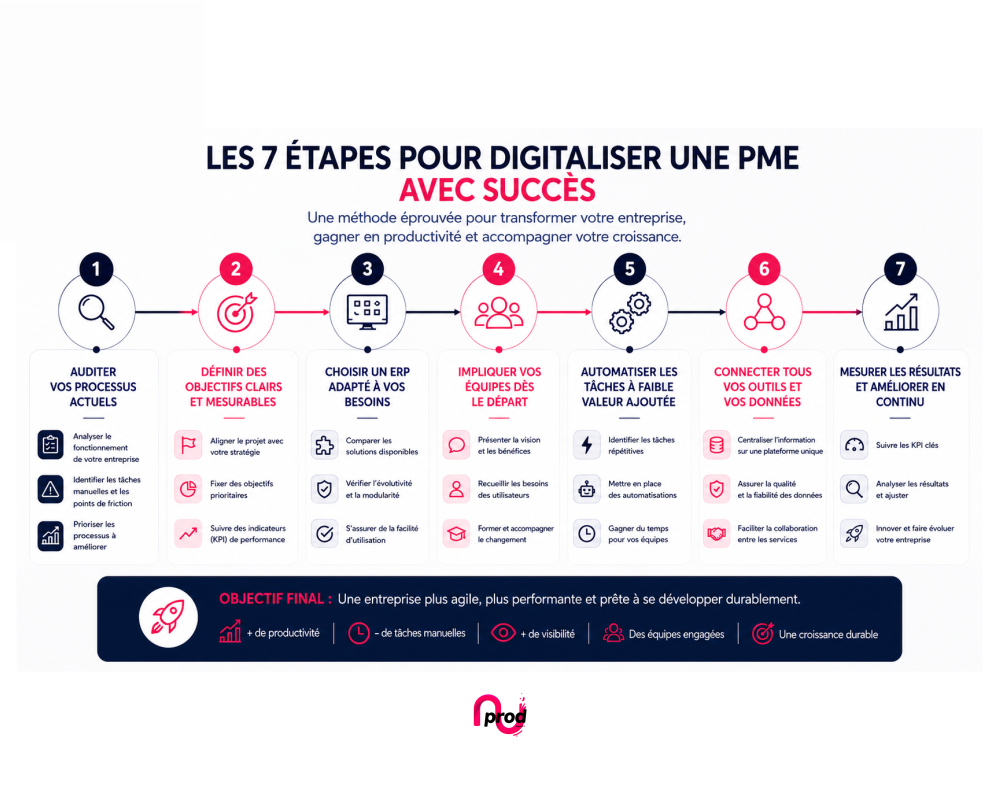
1. Conduct an audit of your current processes
Before choosing software or an ERP, take the time to analyze your current operations.
Ask yourself the right questions:
- Where are we losing the most time?
- What tasks are still being done manually?
- What information is being entered multiple times?
- What software are we using today?
- What processes generate the most errors?
Very often, leaders discover that the real obstacles do not come from employees, but from tools that do not communicate with each other.
The goal of this first step is to identify high-value processes that deserve to be automated.
Nuprod expert advice:never start with software. Always start with the needs of your business.
2. Define clear and measurable objectives
A successful digital transformation must meet concrete objectives.
For example:
✔ reduce administrative time
✔ improve sales tracking
✔ accelerate order processing
✔ limit data entry errors
✔ centralize all company data
✔ improve customer satisfaction
These indicators will then allow for measuring the return on investment of the project.
At Nuprod, we systematically recommend defining a few simple KPIs before starting the project to measure the gains achieved after deployment.
3. Choose an ERP capable of supporting your growth.
Not all SMEs have the same needs.
Some are looking to better manage their inventory.
Others want to structure their business activities or develop their e-commerce site.
The chosen ERP must be able to evolve with your business.
A modern ERP likeOdooallows for the gradual centralization of the different services of the company within a single platform:
- CRM
- Sales
- Purchases
- Inventory
- Accounting
- Production
- Maintenance
- Website
- E-commerce
- Marketing
The goal is not to activate all modules from the start, but to build a scalable system capable of following the development of your SME.
4. Involve the teams from the beginning of the project
The success of a digital transformation project relies as much on the employees as on the technology.
Change can raise questions:
- Will I have to change my habits?
- Will this new tool be complicated?
- Will I lose time?
Involving the teams from the reflection phase allows for gathering their needs and facilitating the adoption of new tools.
The more users are involved in the project, the smoother the transition.
Adequate training and personalized support remain key success factors.
5. Gradually automate low-value tasks.
Automation is one of the main benefits of digitalization.
It allows for the elimination of many repetitive tasks such as:
- data re-entry;
- automatic sending of quotes;
- customer follow-ups;
- supplier orders;
- appointment confirmations;
- stock alerts;
- recurring billing.
By reducing these manual tasks, teams can dedicate more time to missions that truly create value: consulting, customer relations, or business development.
6. Connect all the tools in your business
One of the major goals of digitalization is to avoid the proliferation of independent software.
Your CRM, your website, your sales management, your accounting, and your inventory management must work together.
A unified platform allows for:
- single data entry;
- reliable real-time information;
- better activity management;
- enhanced collaboration between teams.
This centralization significantly reduces the risk of errors and improves the quality of decisions.
7. Measure results and continuously improve
Digital transformation is not a one-time project.
It is a process of continuous improvement.
After deployment, it is essential to monitor the indicators defined at the beginning of the project:
- administrative time saved;
- number of errors removed;
- processing times;
- revenue;
- customer satisfaction;
- team productivity.
This data helps identify new areas for improvement and gradually evolve your information system.
The most successful companies are those that view their ERP as a true strategic management tool, capable of supporting their long-term growth.
The errors that slow down the digital transformation of SMEs
Certain errors frequently occur in digitalization projects.
Identifying them early on helps avoid delays, additional costs, or poor adoption by teams.
Choosing software before defining your needs
An ERP should never be chosen solely for its features.
It must meet your business processes and support your development goals.
Wanting to digitalize everything at once
The most successful projects progress gradually.
Start with the most critical processes before extending digitalization to the entire company.
Neglecting change management
Training users, explaining the benefits, and supporting teams are essential elements for the project's success.
Technology alone is not enough.
Digital transformation in action: a concrete example of an SME supported by Nuprod
The digitalization of a small and medium-sized enterprise (SME) is not a theory. When well-prepared, it produces concrete and measurable results.
At Nuprod, we support companies from various sectors (commerce, industry, services, or trade) in modernizing their tools and processes.
The goal is never to deploy an ERP to replace an existing software.
Our mission is tosimplify the daily lives of teams, centralize information, and provide leaders with a comprehensive view of their business.
Case study: how SubOuest went from 90% paper to a 100% digitalized company
When Wassim took overSubOuest, a specialized diving store in Bordeaux, he discovered an organization very far from current standards.
As he explains in his testimony:
"We were still sending accounting by mail."
The company primarily operated with:
- paper administrative processes;
- a complex inventory management;
- a poorly digitalized workshop;
- several independent tools.
The goal was clear: to restructure the company without interrupting its activity.
After an audit of needs, several actions were implemented:
- creation of a new website;
- migration of nearly3,000 product references; ;
- implementation of the Odoo Point of Sale;
- development of a specific Workshop module;
- integration of appointment management;
- team training.
The results were quick.
| Before | After |
|---|---|
| Mostly paper-based management | 100% digitalized company |
| 8 hours of administrative work per week | 1 hour and 30 minutes per week |
| Workshop deadlines: 8 weeks | Deadlines reduced to 10 days |
| Data spread across multiple tools | Centralized management in Odoo |
As Wassim summarizes:
"Today, everything goes through Odoo: inventory, sales, the workshop, appointments, and accounting."
Discover the complete case study of SubOuestto understand the steps of this digital transformation and the benefits obtained.
What return on investment to expect from a digital transformation?
One of the first questions leaders naturally ask is about the return on investment.
The answer depends on the current level of digitalization of the company, but some benefits appear quickly.
The most frequently observed gains
SMEs that digitalize their processes generally notice:
✔ less time spent on administrative tasks;
✔ a reduction in data entry errors;
✔ better collaboration between teams;
✔ more effective sales tracking;
✔ real-time visibility on performance indicators;
✔ an improvement in customer satisfaction.
Beyond the savings achieved, digitalization primarily allows leaders to dedicate more time to developing their business rather than managing day-to-day operations.
The indicators to follow after your digital transformation
To measure the effectiveness of your project, we recommend tracking several indicators.
| Indicator | Objective |
|---|---|
| Administrative time | Reduce repetitive tasks |
| Order processing time | Improve responsiveness |
| Number of re-entries | Limit errors |
| Customer satisfaction rate | Improve customer experience |
| Response time to prospects | Accelerate the sales cycle |
| Team productivity | Free up time for high-value tasks |
These KPIs allow for an objective assessment of the benefits provided by your ERP and help identify new areas for improvement.
FAQ: the most frequently asked questions about the digitalization of SMEs
Why digitalize an SME?
Digitalization allows for time savings, automates repetitive tasks, reduces errors, and centralizes company data. It also improves collaboration among teams and facilitates decision-making through reliable and up-to-date information.
Where to start the digital transformation of an SME?
The first step is to conduct an audit of existing processes to identify the main obstacles: data re-entry, Excel files, software that does not communicate, lack of visibility, or time-consuming administrative tasks.
How long does it take to digitize a small business?
The duration depends on the size of the company and the scope of the project. Some small businesses start to see benefits within a few weeks through a gradual deployment of the most prioritized modules.
Which ERP should a small business choose?
An ERP designed for small businesses should be scalable, easy to use, and capable of centralizing all of the company's processes. Odoo is particularly appreciated for its modularity, which allows for the gradual addition of necessary features for business development.
Is it necessary to replace all software?
Not necessarily. Digital transformation can be carried out gradually. The goal is to centralize the most important processes before extending digitization to other services.
What is the cost of a digital transformation?
The cost varies depending on the number of users, the deployed modules, and the specific needs of the company. It should be compared to the gains achieved in terms of productivity, automation, and error reduction.
What services can be digitized with an ERP?
Depending on the needs, an ERP can cover commercial management, purchasing, sales, CRM, inventory, production, accounting, marketing, the website, e-commerce, or even human resources.
How can I tell if my company is ready to digitize?
The most common signs are:
- multiplication of Excel files;
- multiple disconnected software;
- daily re-entries;
- lack of visibility on indicators;
- time wasted on administrative tasks.
These situations generally indicate that it is time to structure your information system.
Conclusion: digital transformation is a business project before it is an IT project.
Digitizing a small business is not just about installing a new tool.
It is a comprehensive approach aimed at simplifying processes, improving collaboration between teams, and empowering leaders to manage their activities with reliable data.
Companies that successfully undergo digital transformation are those that progress gradually, relying on a method, clear objectives, and a partner capable of understanding their business challenges.
AtNuprod, we support small businesses at every stage of their project: process audit, module selection, Odoo integration, team training, and continuous optimization.
Because a successful digital transformation is not just about software. It must primarily create value for your business.
Take action
Do you want to know where your business stands in its digital transformation?
👉 Book a free audit with a Nuprod expertand identify the processes that can be automated to increase productivity.
Or
👉 Discover our customer case studies, like SubOuest, to see concretely how SMEs have modernized their organization thanks to Odoo.