
Your e-commerce site automatically records an order. It is transferred to your ERP, the stock is updated, the delivery note is generated, and the team prepares the products. Up to this point, the process is quite smooth.
Then comes the time to ship.
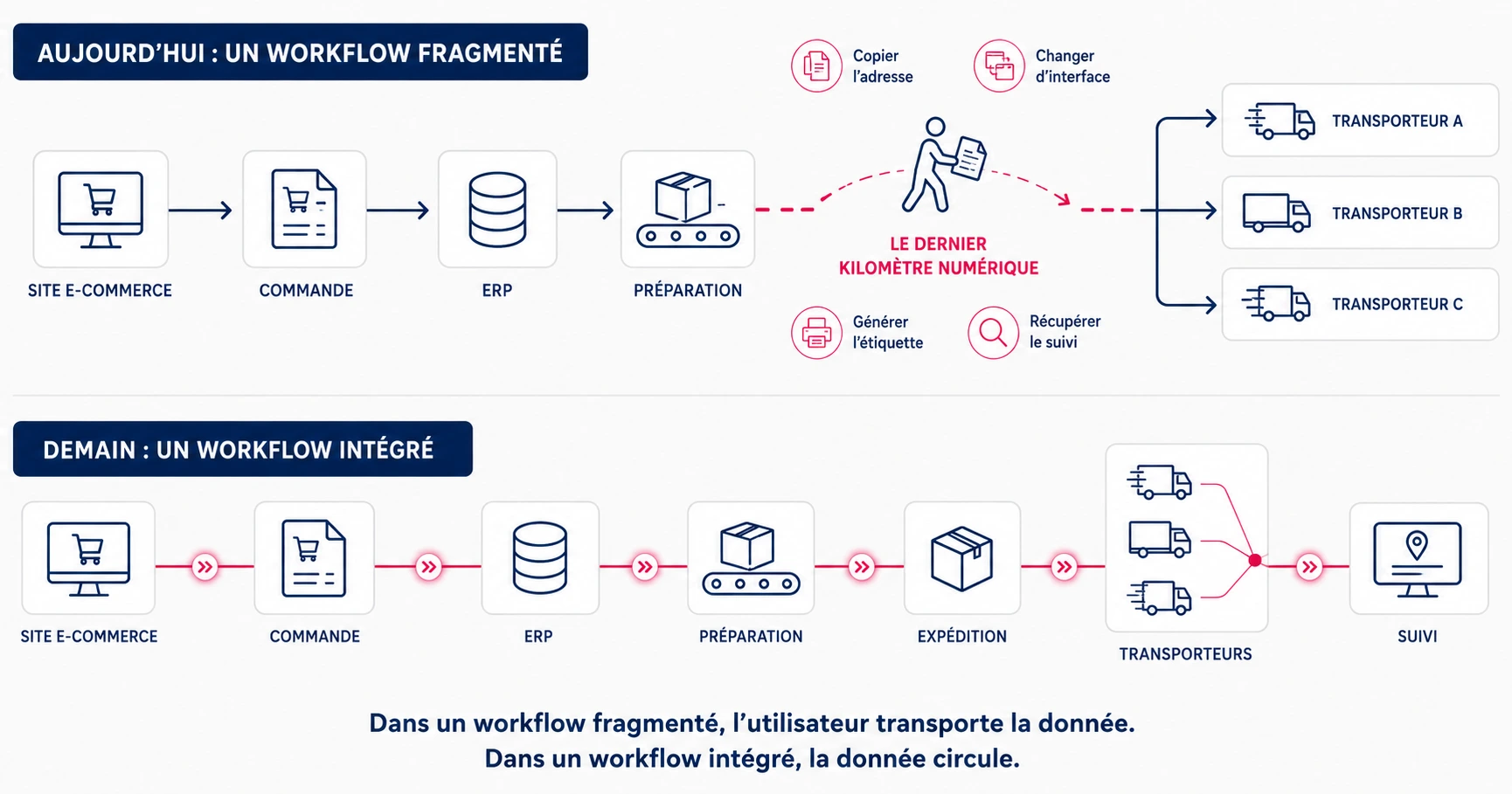
An employee opens the carrier's portal, retrieves the address from the ERP, fills in the necessary information, generates a label, downloads the document, and then returns to their management system. And when multiple carriers are used, it is sometimes necessary to repeat the operation on several different interfaces.
It is often at this precise point that automation stops.
Multi-carrier management has become a real issue for many B2B and e-commerce companies. Customers want to be able to choose between home delivery, pickup points, or express, while companies seek to select the service best suited to the price, delivery time, destination, or characteristics of each shipment.
The problem is therefore not using multiple carriers.It arises when each carrier brings its own portal, its own processes, and a new break with the rest of the information system.
At Nuprod, our stance is quite simple: if information already exists in your ERP, your team should not have to enter it a second time to ship an order.
So, how do you organize effective multi-carrier management without turning shipping into a stack of tools? And above all, how do you maintain continuity between the e-commerce site, the ERP, order preparation, and the carriers?
That’s what we are going to see.
To remember: good multi-carrier management is not just about having multiple delivery options. It is mainly about integrating them into the same workflow so that information flows from the order to shipping without unnecessary re-entry.
1. Multi-carrier meets a real need… but also creates complexity
When a company starts shipping a few orders, the transportation question is generally quite simple. A main carrier, a method known to the team, and a few manual operations are enough to handle the volume.
The situation evolves as the business grows.
Not all customers have the same expectations, and not all orders can necessarily follow the same logistical path. A standard home delivery may perfectly suit one order, while another may require a pickup point, an express service, or a solution tailored to a specific destination.
Working with multiple carriers then becomes less of a choice and more of a natural consequence of the diversification of needs.
In e-commerce, delivery starts before the warehouse
This is particularly visible in e-commerce. Transportation does not only come into play when the package is ready: it is already part of the purchasing journey.
At checkout, a consumer may want to choose between an economical delivery to a pickup point, a more comfortable home delivery, or a more expensive express service. So, they do not simply choose a carrier. They choose between a price, a timeframe, and a level of service.
This freedom of choice can become an important element of the experience offered by the merchant. But it also creates an additional requirement: what the customer chooses on the site must then be correctly transmitted to the rest of the process.
Let's take a simple case. A customer selects a pickup point and confirms their order. If this information does not correctly flow into the system used by the logistics team, someone will have to find it, verify it, and then report it when creating the shipment.
The problem then no longer comes from the carrier. It comes from the flow of information between the tools.
In B2B, the choice is less visible but just as strategic.
In a B2B environment, the carrier is not necessarily chosen directly by the customer at checkout. The decision may be made by the company based on weight, number of packages, destination, urgency, or the conditions agreed upon with the customer.
But the underlying problem remains the same.
As use cases multiply, the team must be able to select the appropriate service without manually reconstructing the shipment each time.
This is where an important distinction arises: having multiple carriers is not the same as knowing how to manage multiple carriers.
In the first case, the company has multiple accounts. In the second, it has a process capable of functioning consistently regardless of the provider used.
The "digital last mile" of the order
There is a fairly common paradox in companies equipped with an ERP.
A large part of the business cycle is already integrated. The CRM feeds sales, the order triggers stock movements, teams have a delivery note, and customer information is centralized in the system.
Then, at the time of shipping, a user opens a new tab.
They log into the carrier's portal and start entering information that the company already has.
There is a lot of talk about the last mile to refer to the final physical step of delivery. But just before this, there sometimes exists what could be called the digital last mile : the few computer meters that separate the delivery note from the carrier label.
And they are sometimes surprisingly manual.
An address already exists in the ERP. The recipient's name does too. The order is known, just like the prepared products. Yet, if the carrier operates in a completely separate environment, an employee becomes the interface between the two systems.
At low volume, this organization may go unnoticed. As shipments increase, it becomes much more visible.
2. The true cost of fragmented shipment management
The first cost that comes to mind is naturally time.
Copying an address, selecting a service, and retrieving a label does not seem particularly time-consuming when done once. But a repetitive task must always be observed at the scale of the volume at which it is performed.
Let’s take a deliberately simple example. If the manual transfer between the ERP and the carrier portal takes only two minutes per shipment, 50 daily packages already represent 1 hour and 40 minutes of handling. Over five days, that exceeds eight hours.
This calculation is purely illustrative: each organization obviously has its own workflow and processing times. However, it highlights a classic phenomenon in automation projects: it is not necessarily the large tasks that consume the most time, but the small actions repeated hundreds of times.
And time is only part of the equation.
Where do manual tasks hide in shipment management?
| Step | Fragmented management | Possible consequence |
|---|---|---|
| Retrieving the address | Copying from the ERP to the carrier portal | Lost time, data entry error |
| Choosing the carrier | Navigating between multiple interfaces | More complex comparison and processing |
| Creating the shipment | Information entered again | Multiplication of handling |
| Generating the label | Label retrieved from the relevant portal | Scattered documents |
| Delivery rate | Information potentially processed in multiple systems | Gap between checkout, order, and processing |
| Tracking number | Retrieval and then reporting in the management system | Fragmented information |
| Search after shipping | Consultation of the carrier's portal | Extra time for customer service |
Then I would just add a small Nuprod paragraph below:
Taken separately, none of these actions is particularly problematic. It’s their accumulation that is. And that’s often what makes these time losses difficult to identify: no one spends three hours at a time re-entering data. Everyone loses a few minutes, all day long.
Re-entry also creates error
When information passes automatically from one system to another, it remains the same. When a user has to copy it, a new possibility for error arises.
A wrong address, an incorrect postal code, a recipient selected too quickly, or a wrong delivery service may seem like small IT anomalies. But in a logistics process, they can quickly have a physical consequence: delay, return of the package, new shipment, or customer dissatisfaction.
That’s why we tend to consider re-entry as an interesting signal when analyzing a business process.
If data is already available somewhere, why do we ask someone to recreate it elsewhere?
The answer is generally that two tools do not communicate sufficiently with each other.
The multi-carrier amplifies the problem
This fragmentation becomes even more visible when multiple carriers enter the equation.
A team can use Colissimo for certain orders, Mondial Relay for deliveries to pickup points, Chronopost for express, and then DHL, UPS, or FedEx for other needs. Each carrier can then bring its interface, its identifiers, its methods of creating shipments, and its working habits.
The employee must no longer just know how to prepare a shipment. They must know how to prepare it according to the tool used that day.
This is where the multi-carrier can become paradoxical. It brings more commercial and logistical flexibility, but can also create more operational complexity.
The goal is therefore not to artificially reduce the number of carriers to simplify operations. It is rather to decouple the internal workflow from the chosen carrier.
In other words: the provider can change, but the way the team works should remain as stable as possible.
The delivery rate is also part of the data flow
For e-commerce companies, another break can appear well before the generation of the label: that of the price.
When a customer selects a delivery at checkout, they generally see an amount associated with this service. This price contributes to the total of their order and sometimes directly influences their purchasing decision.
Therefore, this choice must remain consistent in the subsequent processing.
If the customer selects an offer at a given price but the team then has to manually rebuild this information in the ERP, we recreate a friction point. There may then be a difference between what the customer chose, what the order contains, and what the teams are actually processing.
In a well-integrated system, the logic should be much more natural: the delivery method chosen at checkout becomes a piece of order data, just like the products or the delivery address.
The team does not have to reinterpret the customer's choice. They retrieve it and continue the process.
A shipment does not stop at the printing of the label
The generation of the label is often presented as the culmination of a transport integration. In reality, it is just a step.
Once the package has left, the company must still be able to find the carrier used, the tracking number, and the necessary information when a customer calls or when an anomaly occurs.
If this information remains only in the carrier's portal, the team still has to leave their work environment to understand what happened.
The real challenge is therefore to preserve the continuity of data throughout the order cycle.
Transport should not be a technical appendix added at the end of the process. It is part of the process.
3. What does truly integrated multi-carrier management look like?
When observing the problem from this angle, the solution does not necessarily consist of adding more tools. It mainly involves improving the flow of information between those that already exist.
In an ideal e-commerce journey, the customer starts by choosing the delivery that suits them. Their choice, pricing, and necessary information are associated with the order. When it arrives in the ERP, the teams already have what they need to continue processing.
Preparation can then take place in the usual system. At the time of shipping, the data from the delivery note is used to create the shipment without a team member having to retype the address in a new interface. The label is generated, and the tracking information remains associated with the order.
The workflow then becomes:
Order → ERP → preparation → carrier → label → tracking
What matters here is not so much the length of the chain as the absence of breaks between its different stages.
In B2B, the principle is the same. The customer may not necessarily choose their carrier themselves, but the team can select the appropriate service based on the order information, and then continue shipping without manually reconstructing the data.
The carrier must be able to change without changing the business
This is probably one of the most important criteria for a good multi-carrier organization.
Imagine that a preparer has to learn a completely different procedure for each provider. As the company adds carriers, it also adds complexity to its organization.
Conversely, if the process remains centered on the order or the delivery note, the carrier becomes a variable of the workflow rather than the workflow itself.
This approach obviously makes it easier for teams to take over, but it also makes the organization more scalable. Adding a new delivery option should not require rethinking the entire way orders are prepared.
Should we go through a multi-carrier platform?
From a certain volume or a certain level of diversity in shipments, centralizing carriers naturally becomes interesting.
But one must beware of a shortcut: centralizing does not necessarily mean integrating.
You can very well replace five carrier portals with a single platform… while still manually copying information from your ERP to this platform.
You have then reduced the number of tabs, but not necessarily eliminated the main break.
That is why the number of available carriers should not be the only criterion for choosing a solution. It is especially important to look at how it fits into your existing system.
Can it retrieve data already present in the ERP? Does the choice made at checkout actually follow the order? Does the team still have to enter addresses? Is the delivery rate consistent between the site and the management system? Do tracking information return to the right place?
These questions are less spectacular than a large catalog of features. But they are what determine the number of clicks your teams will make each day.
Automating does not mean eliminating all human intervention
There is also an important point when talking about logistics automation.
The goal is not necessarily to eliminate all human decision-making.
A collaborator may very well need to select a service, check an exception, or decide that an order requires special handling. Some business situations need arbitration.
Good automation is rather about distinguishing what truly requires a decision from what is merely a mechanical repetition.
Choosing the best shipping method for an unusual order may require expertise.
Copying an address already recorded in the ERP requires none.
It is this distinction that allows for the construction of truly useful automations rather than complex systems that seek to automate for the sake of automating.
ERP and carriers: eliminating the last silo
Companies have gradually connected a large part of their operational chain. The CRM communicates with sales, sales with inventory, inventory with preparation, and billing retrieves information from orders.
It would be quite strange for shipping to remain permanently outside of this logic.
And yet, it is still often at the moment when the package is to leave the company that copy-pasting, interface changes, and scattered information reappear.
This is what we referred to earlier as the digital last mile.
Solving it does not necessarily mean finding a tool that can do everything. It is more about ensuring that the management system, the e-commerce journey, and the carriers can exchange enough information so that the team no longer has to act as an intermediary between them.
A good integration is often one that the user eventually no longer notices.
He prepares his order, generates his shipment, and continues his work.
The carrier does his job.
The ERP does its job.
And the data flows between the two.
FAQ: multi-carrier management and shipment automation
What is multi-carrier management?
Multi-carrier management involves being able to use multiple carriers or delivery services within the same logistics process. The challenge is not only to have access to several providers but to maintain a consistent processing method when the carrier varies according to the order.
Why offer multiple carriers on an e-commerce site?
Multiple options allow for different expectations regarding price, delivery time, or delivery method. Some customers prefer pickup points, others home delivery or express. The challenge then is to correctly reflect the choice made at checkout in the order processing.
How to automate e-commerce shipments?
An important part of automation involves connecting the data from the e-commerce site, the ERP, and shipping. The address, delivery method, and order information can thus be reused to create the shipment without systematic re-entry.
What is the benefit of connecting your carriers to your ERP?
Integration allows for continuity between the order, its preparation, and its shipping. It can notably reduce re-entries, limit certain errors, and enable teams to more easily find transport information in their usual work environment.
How to choose a multi-carrier software or platform?
Beyond the number of carriers offered, one must look at the quality of the integration with your existing environment. A relevant solution must primarily reduce workflow disruptions: re-entry of addresses, transfer of the delivery method, generation of labels, and retrieval of tracking information.
What if transport was no longer a separate tool?
Your customer has placed their order. Your ERP already knows their address. Your stock knows which products need to be shipped, and your team has the delivery note.
Why should part of the work be redone at the time of shipping?
This is ultimately the central question.
The future of multi-carrier management probably does not consist of stacking more and more interfaces around the ERP. It is rather about making the transition from order to shipping smooth enough for transport to become a natural continuity of the process.
At Nuprod, this famous last digital mile between the ERP and the carriers is currently keeping us quite busy. And it's not entirely a coincidence.
We'll talk to you about it very soon.
If you have any questions or wish to improve multi-carrier management, don't hesitate to check in with a Nuprod expert.